
Canada Doesn't Just Need More Homes. It Needs Different Ones.
Canada Doesn't Just Need More Homes. It Needs Different Ones.
I want to start somewhere personal, because this isn't just a demographic observation for me. I watched my parents go through this. After decades in a home they loved, the time came to simplify — and what should have been a straightforward transition became something far more complicated and emotionally difficult than any of us anticipated.
Not because selling was hard. It wasn't, really. The hard part was what came next. Where do you actually go? What exists that gives you privacy, independence, manageable space, and the ability to stay connected to the community and the family you've built your life around? For my parents — as for so many Canadian seniors I've worked with over nearly four decades in this industry — the honest answer was: not much.
That gap is what I want to talk about. Not as an abstract policy problem, but as something I've lived personally and professionally, and something I believe is about to reshape Canadian housing more profoundly than interest rates ever will.
The Demographic Pressure Already Building
Statistics Canada data shows that nearly one in four Canadians will be over the age of 65 within the next decade.[1] CMHC has been explicit: supply and demographics are on a collision course, and the early signs are already visible in markets from Victoria to Halifax.[2]
Here's what the housing conversation often misses: the problem isn't only that there aren't enough homes. It's that the homes being built — and the homes that exist — don't match what a rapidly aging population actually needs.[2] We keep building tall towers and entry-level condos. Meanwhile, the largest cohort in Canadian history is looking for something that falls almost entirely in between: smaller, simpler, private, ground-oriented, and designed for how people actually live as they get older.
Why Seniors Stay — And What It Costs Everyone
The housing market is frequently described as "stuck." Inventory is tight. Listings feel limited. Buyers feel frustrated. And while interest rates get most of the blame, the more structural force driving this gridlock is behavioral: millions of Canadians are staying in homes that no longer fit them, because the right alternative doesn't exist.[3]
Think about what's actually happening. A senior couple in their late sixties. House paid off. Kids grown. The stairs are getting harder. The yard is becoming a burden. The heating bill on a 3,000-square-foot home for two people makes less and less sense. The retirement strategy — buy a home, grow equity, sell and downsize — was supposed to generate freedom. But freedom requires somewhere to go.
So they look at condos. And here's where the math breaks in ways that aren't obvious from the outside. After a lifetime of being mortgage-free, they're now facing strata fees, monthly carrying costs, utility payments, special levies — and often less space for more money than they expected. The psychological shift is enormous. They did everything right. And now they're being asked to pay more monthly, for less, with less control. That doesn't feel like retirement. It feels like a step backward.[3]
The Gridlock Effect
When seniors don't move, the homes below them don't free up. Families who need to upsize can't find room. First-time buyers compete not just against each other but against downsizing seniors who want the same low-maintenance, ground-level, freehold inventory.[3] Every layer of the housing ladder stalls. This is not a pricing problem alone — it is a product problem.
What Seniors Actually Want — And Why Condos Often Aren't It
After nearly forty years designing homes, advising clients through housing transitions, and now living through this personally with my own family, I can tell you clearly: most seniors do not want to move into a high-rise condo. They don't want elevators. They don't want shared walls, shared hallways, and shared amenity spaces. They don't want to give up a small patch of garden or an outdoor space they can step into without a lobby.[3]
What they want is something that doesn't really have a clean category in the Canadian housing market:
- One-level living, or a primary bedroom on the main floor
- A small, manageable outdoor space — a patio, a courtyard, a garden they can actually tend
- Private entrance — no shared corridors, no common lobbies
- No stairs, or very few
- Low exterior maintenance
- Proximity to family, community, familiar neighbourhoods
- Independence and privacy, not institutional living
This is why bungalows are in such extraordinary demand — and why there are never enough of them. A well-maintained bungalow in an established neighbourhood sells fast and often above asking, regardless of broader market conditions, because it is the closest thing available to what this cohort is actually looking for.[3]
The Other Side: Families Staying Together Longer
This conversation has another dimension that gets less attention but is equally significant. It's not just seniors who need different housing. It's the families around them.[3]
Adult children are staying in the family home longer — not because they want to, but because the entry point to homeownership has moved far beyond reach for many. At the same time, aging parents increasingly need proximity: not necessarily to live together, but to live nearby. Close enough for support. Close enough for shared meals and spontaneous connection. But with genuine independence and privacy on both sides.
This is multi-generational living — and it is already happening organically across Canada, driven by financial necessity and family reality. What we don't have is housing actually designed for it.
In my design work over the decades, I have created multi-generational spaces in many forms: secondary suites with private entrances, detached garden suites, duplex configurations where extended family can be together but separate, attached townhomes where a parent suite connects to a main residence through a lockable interior door. These configurations work. Families who live in them are not making a compromise — they are living better.
Design Insight — What Makes Multi-Generational Housing Actually Work
The difference between multi-generational housing that functions well and housing that creates friction is almost always about design. Separate entrances. Sound separation. Private outdoor space for each unit. Adaptable layouts that can shift over time as needs change. Lighting designed for aging eyes. Wider doorways and level thresholds built in from the start, not retrofitted. These are not expensive features — but they have to be intentional. They don't happen by accident.
What B.C.'s Bill 44 Actually Makes Possible
This is where the policy conversation intersects with the demographic one in a way that I find genuinely significant — and underappreciated.
B.C.'s Bill 44 — the Housing Statutes (Residential Development) Amendment Act — mandates that municipalities with populations over 5,000 allow multiplexes on traditional single-family lots. This is not optional. It is a provincial floor that municipalities must meet, regardless of local resistance.[4,5]
The core density provisions:[4]
- 3 to 4 units are permitted on parcels currently zoned single-family or duplex. Lots under 280 m² may allow 3 units; larger lots allow 4.
- Up to 6 units are permitted on larger lots within prescribed proximity to frequent transit stops.
- Secondary suites or detached accessory dwelling units — such as laneway homes — must now be permitted on any single-family lot at minimum, across all local governments.[5]
For transit-oriented areas, the density baselines go further: up to 20-storey heights and 5.0 FAR within 200 metres of a rapid transit hub, stepping down through 12-storey and 8-storey permissions as distance increases.[6]
Municipal Resistance Is Real — But the Province Is Holding the Line
A coalition of Metro Vancouver mayors — including representatives from Surrey, Burnaby, and Richmond — have lobbied actively to repeal these density mandates, citing infrastructure and utility financing costs. The province has not moved. The density floors stand.[5,6] For property owners and developers, the opportunity window created by this legislation is real, even where local governments remain resistant.
What this means practically: a well-located older home on a larger lot — something very common in West Vancouver, North Vancouver, and the established neighbourhoods of Squamish — may now be a canvas for exactly the kind of housing that Canada's aging population needs. A triplex with one accessible ground-floor unit. A duplex where a parent lives independently while remaining close to family. A courtyard sixplex designed around shared outdoor space with private entrances for each household.
The legislative foundation is there. The demographic demand is there. What's still missing is the design imagination and the development will to build the right product.
What This Housing Can Actually Look Like: Real Design Examples
One of the most useful resources available right now — and one that most people have never heard of — is the CMHC Housing Design Catalogue: a free, publicly available library of over 50 regionally tailored, architect-designed housing plans for exactly the kind of gentle density and multi-family living I've been describing.[7]
These are not concept drawings. They are full technical packages — floor plans, building dimensions, and construction documents — developed by local architects and engineers to comply with regional building codes. They cover accessory dwelling units, rowhouses, townhomes, fourplexes, and sixplexes. British Columbia has its own dedicated set of designs. And some of them are exactly the missing product I've been talking about.
Here are two BC designs from the catalogue that illustrate what this can look like in practice.
CMHC Housing Design Catalogue — BC Designs
The following examples are drawn directly from the CMHC Housing Design Catalogue — British Columbia. All designs are free to download, adaptable, and developed to meet BC building code requirements. Technical packages including full floor plans, structural drawings, and specifications are available at no cost.[7]
Courtyard Sixplex
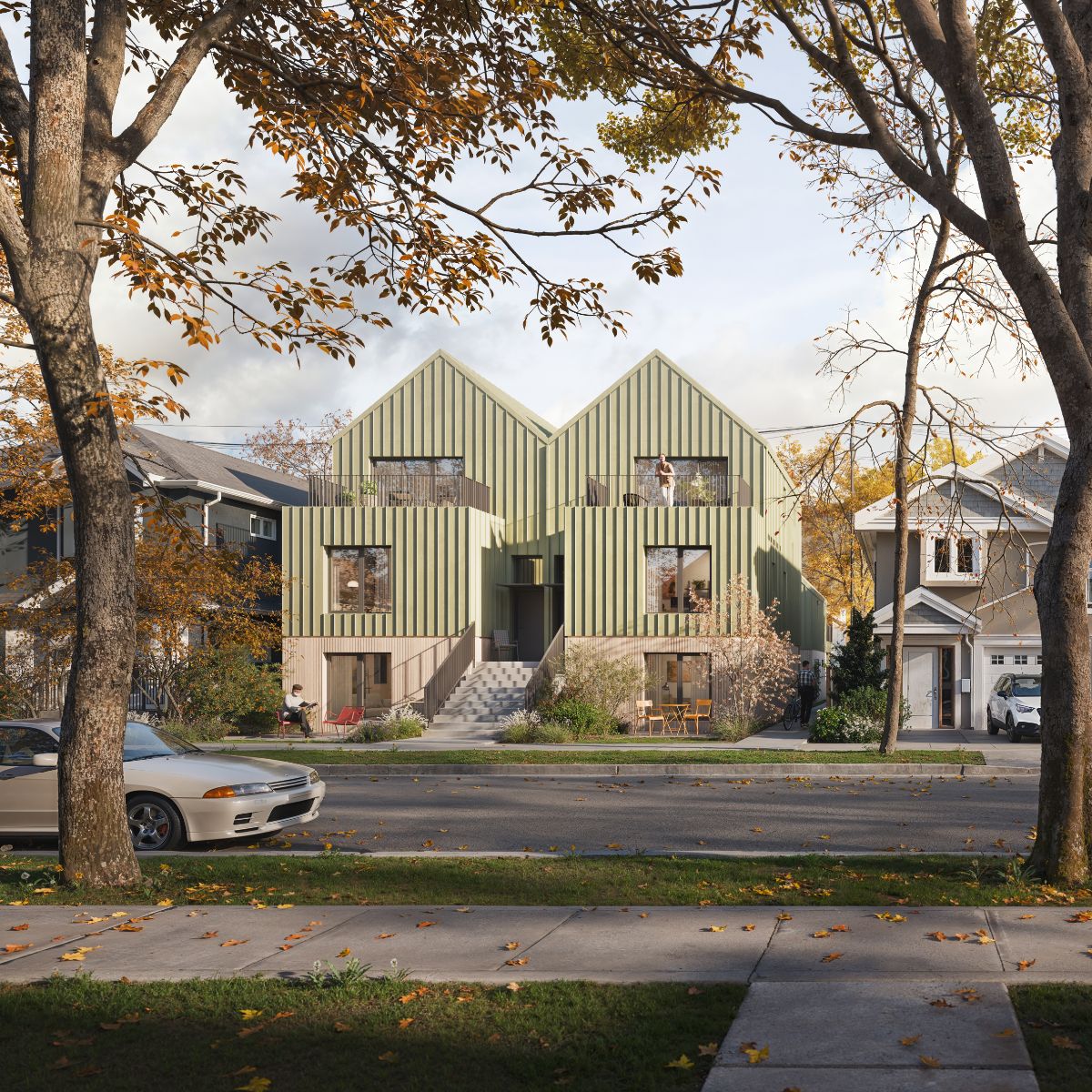
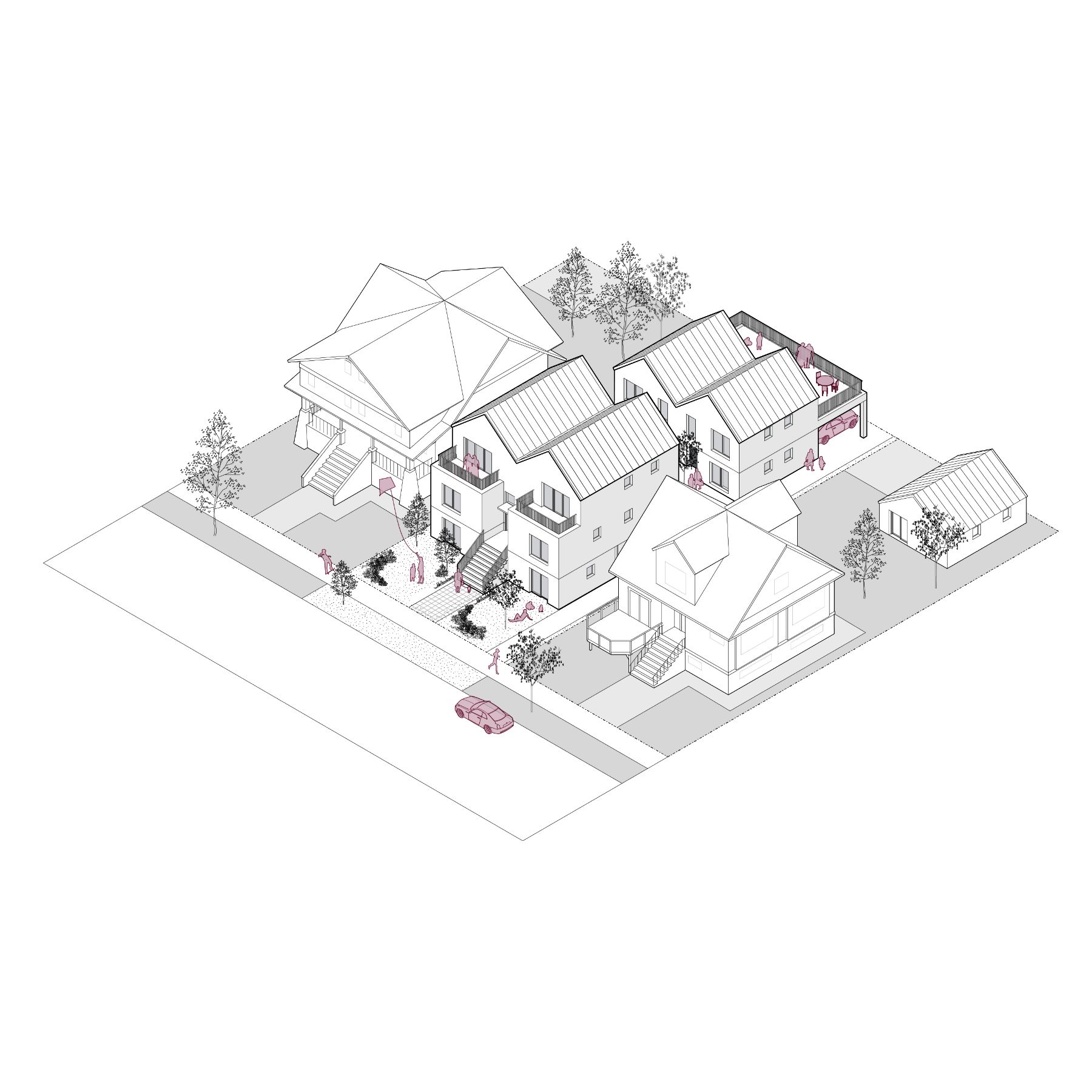
This is the design that most closely represents the missing housing product I've been describing for years. Six units arranged around a shared courtyard — but each with its own private entrance, its own outdoor patio space, and no shared corridors or lobbies. Four units at the front, two at the rear. Optional adaptable unit configurations are built into the design from the start, meaning aging-in-place features can be incorporated without retrofitting later.
This is the kind of project that becomes possible on a larger West Vancouver or North Vancouver lot under Bill 44's six-unit permissions near frequent transit. It fits into an established neighbourhood without overwhelming it. It provides exactly the ground-level, private, manageable living that seniors are looking for — while also working beautifully for multi-generational families who want to be close but independent.
View Full Design & Download Plans →Main Floor Plan — Courtyard Sixplex (BC)

Fourplex 02
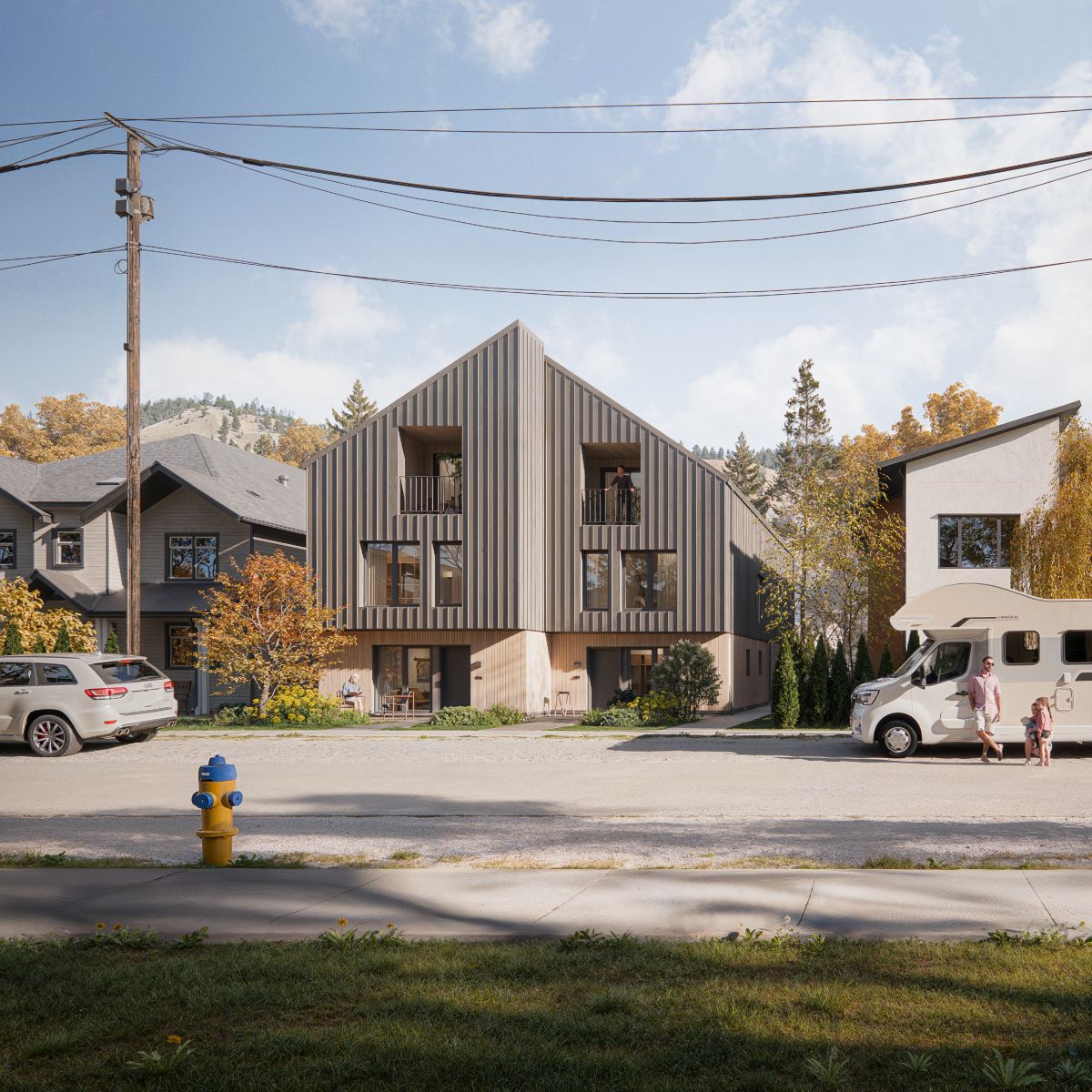
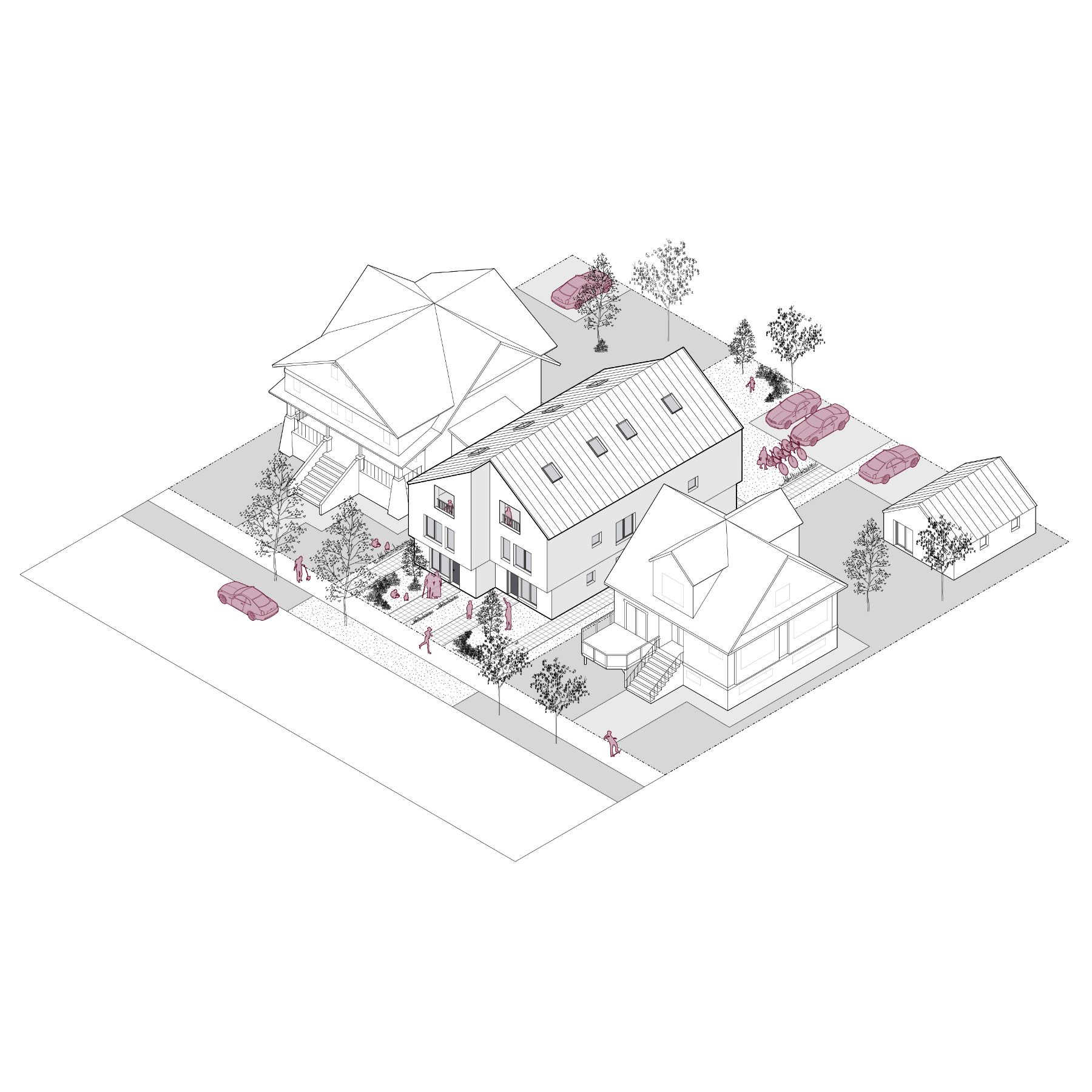
The BC Fourplex 02 is designed to fit into a variety of existing neighbourhood contexts — the kind of infill that doesn't look out of place beside a 1960s bungalow or a newer custom home. Four full three-bedroom units, each with 2.5 bathrooms, across three storeys. Each unit includes an office or flex room, which in a multi-generational context could serve as a bedroom for an aging parent, a caregiver suite, or a work-from-home space.
For a family buying a larger lot with the intention of keeping multiple generations close, this design represents a viable path. One unit for parents, one for adult children, and two that can be rented to offset costs or housed additional family. The math on lot redevelopment changes significantly when the finished product delivers this kind of flexibility.
View Full Design & Download Plans →Main Floor Plan — Fourplex 02 (BC)

This Is Happening Everywhere — Including Cape Breton
I want to be clear about something: this is not a Vancouver problem. It is not a Metro problem. It is a national problem, and the examples that make it most visible often come from places you wouldn't expect.
Cape Breton has been actively developing one-level senior housing to address exactly this demand — and the units fill immediately. The inventory is never sufficient. Communities that don't typically make headlines in housing conversations are experiencing the same structural mismatch: seniors in large homes who want to downsize into something appropriate, and almost nothing available for them to move into.[3]
When this pattern appears in Cape Breton and in West Vancouver simultaneously, it is no longer a local market anomaly. It is a demographic signal. And demographic signals of this magnitude don't reverse.
Redevelopment Opportunity — What Older Lots Can Become
For property owners sitting on larger or older lots in established neighbourhoods — particularly in West Vancouver, North Vancouver, Squamish, and communities along the Sea-to-Sky corridor — the combination of Bill 44 density permissions and demographic demand creates a meaningful strategic conversation.
An older home on a 10,000-square-foot lot in an established West Vancouver neighbourhood is no longer just a renovation candidate. Under current provincial legislation, it may support a triplex or fourplex.[4] Designed thoughtfully — using a plan like the CMHC Courtyard Sixplex as a starting point — that development could house a multi-generational family across independent units, or deliver exactly the product the market is most desperately short of: ground-oriented, private, one-level homes within walking distance of services, transit, and community.[7]
What a Redevelopment Analysis Looks At
Lot size and configuration. Current zoning and Bill 44 applicability. Distance to transit (for 6-unit permissions). Existing structure value vs. land value. Development feasibility and cost modelling. Highest and best use — which may be a thoughtfully designed multiplex rather than a single custom home. Long-term value trajectory under different development scenarios. This is the full picture, and it matters more than the current assessed value.
What Comes Next — And Why It Matters Now
The demographic wave is not arriving. It is already here, moving slowly enough that it doesn't generate daily headlines, but large enough to structurally reshape Canadian housing behaviour over the next decade.[1,2]
Seniors will eventually move — not always by choice, but by necessity. Health events. Mobility changes. The inability to manage a large home alone. When those transitions happen at scale, the market moves.[3] Not because people want to sell. Because they need to.
For families watching aging parents navigate this, the most valuable thing you can do is start the conversation early — before necessity forces the decision. For property owners sitting on larger lots, the window to evaluate redevelopment options is open now, while the policy framework is clear and the demand is unmistakable. For buyers, understanding that the competition for low-maintenance, ground-level, freehold homes will intensify — not soften — is part of making a sound long-term decision.
Frequently Asked Questions
Questions I hear often from clients navigating aging, downsizing, multi-generational living, and redevelopment decisions in today's market.
My parents want to downsize but nothing feels right. What should they actually be looking for?
The honest answer is that the product most seniors want — private, ground-level, low-maintenance, right-sized, in an established neighbourhood — is genuinely undersupplied in most Canadian markets.[2,3] I recommend starting with function: what does daily life actually need to look like in five and ten years? That means assessing stairs, bedroom location, outdoor access, proximity to family and services, and maintenance obligations. From there, we can evaluate what exists and whether a custom or redevelopment solution makes more sense than waiting for the right listing to appear.
What is aging-in-place design, and when should we be thinking about it?
Aging-in-place design means building or renovating a home so it functions well across a long lifespan — not just for today's needs, but for future ones. This includes wider doorways (at least 36 inches), level or zero-step thresholds at all entries, a primary bedroom and full bathroom on the main floor, lever-style hardware, well-lit hallways and staircases, walk-in showers with no curb, and reinforced walls near toilets and showers for future grab bar installation. The CMHC Housing Design Catalogue incorporates optional adaptable unit configurations into several of its BC designs — including the Courtyard Sixplex — specifically to support these principles from the start.[7] The best time to incorporate these features is during new construction or a significant renovation. Retrofitting them later is possible but far more expensive and disruptive.
What does Bill 44 actually change for homeowners in B.C.?
Bill 44 removes the ability of municipalities to prohibit multiplexes on single-family and duplex lots.[4] Practically, this means most homeowners in B.C. communities with populations over 5,000 can now build 3 to 4 units on their lot, and up to 6 units if the lot is larger and near frequent transit. Secondary suites and detached accessory dwellings (like laneway homes) must now be permitted everywhere.[5] This is a significant shift — it changes the conversation from "is this allowed" to "is this the right strategy for this property." The answer depends on lot size, location, construction costs, and long-term goals.
Is multi-generational living actually a good idea, or is it just a financial compromise?
In my experience — both personal and professional — well-designed multi-generational housing is not a compromise. It is often a better way to live. The critical word is "designed." When multi-generational housing fails, it almost always fails because of poor design: insufficient sound separation, shared entrances that eliminate privacy, inadequate outdoor space, no sense of independence for each household. When it's done well — separate entrances, private outdoor spaces, adaptable layouts, genuine acoustic separation — the families who live in it are among my most satisfied clients. The CMHC catalogue's courtyard and fourplex designs are built around exactly these principles.[7]
What is the CMHC Housing Design Catalogue and is it actually useful for BC homeowners?
The CMHC Housing Design Catalogue is a free, publicly available library of over 50 standardized housing designs developed specifically for Canadian regions, including a dedicated British Columbia collection.[7] The designs cover accessory dwelling units, duplexes, triplexes, fourplexes, rowhouses, townhomes, and sixplexes. Each comes with a free downloadable technical package — floor plans, dimensions, and structural documentation — developed by local architects to meet BC building code. They are meant to be adapted, not used as-is, but they give property owners, developers, and municipalities a real starting point for exactly the kind of infill housing Canada needs more of. The BC Courtyard Sixplex and Fourplex 02 shown above are two of the most directly relevant designs for the multi-generational and aging-in-place conversation.
My parents' home has development potential. How do I start evaluating it?
Start with the basics: lot size, current zoning, proximity to transit, and what Bill 44 permissions apply.[4] Then look at the relationship between the existing structure's value and the land's value — in many older West Vancouver and North Vancouver properties, the land value significantly exceeds the value of the home on it, which changes the calculus entirely. From there, a development feasibility conversation covers construction cost estimates, what product types the market actually wants, and what the financial return looks like under different scenarios. Reviewing CMHC catalogue designs for your region is a useful early step — it gives you a concrete sense of what a well-designed multiplex looks like on a standard lot before engaging an architect or developer.[7] This is a conversation I have regularly with property owners, and the answers are often surprising in both directions.
Sources & References
- [1] Statistics Canada — Population projections: nearly 1 in 4 Canadians projected to be over age 65 within the next decade. statcan.gc.ca
- [2] CMHC — Canada Mortgage and Housing Corporation — Housing supply and demographic collision analysis; Canada's Housing Supply Shortages: Estimating what is needed to solve Canada's housing affordability crisis by 2030. cmhc-schl.gc.ca
- [3] ReMax Canada — Downsizing wave research and senior housing behaviour analysis, 2025–2026. remax.ca
- [4] Province of British Columbia — Housing Statutes (Residential Development) Amendment Act (Bill 44), 2023. Core density allowances, multiplex permissions, and transit-oriented development provisions. news.gov.bc.ca
- [5] UBCM — Union of BC Municipalities — Provincial housing legislation introduces sweeping changes to local government: secondary suites, multiplex mandates, and implementation context. ubcm.ca
- [6] City of Burnaby — Provincial housing legislation changes: transit-oriented density baselines and FAR requirements under Bill 47. burnaby.ca
- [7] CMHC Housing Design Catalogue — Free, regionally tailored standardized housing designs including BC-specific ADUs, rowhouses, townhomes, fourplexes, and sixplexes. Technical packages available for download at no cost. housingcatalogue.cmhc-schl.gc.ca — BC designs: Browse BC Designs — Courtyard Sixplex: View Design — Fourplex 02: View Design
- [8] Debbie Evans — Nearly 40 years of direct professional experience in design, construction, renovation, and real estate across West Vancouver, North Vancouver, Squamish, Whistler, and the Sea-to-Sky corridor. westvanliving.ca
I've been covering the B.C. density legislation in a dedicated short-form video series — breaking down what multiplexes, transit-oriented density, and secondary suite rules mean practically for homeowners and buyers across the province. Catch the latest updates on my channel.
Debbie Evans | REALTOR® & Registered Interior Designer
eXp Realty | West Vancouver, North Shore & Sea-to-Sky Markets
If you're trying to figure out whether your current home still serves your family's next chapter — or whether a property you own has development potential worth evaluating — that conversation is worth having before circumstances force the decision. I bring nearly forty years of design, construction, and real estate experience to these discussions. I understand both the emotional side and the strategic side, because I've lived both.
This content is for informational and educational purposes only and does not constitute financial, legal, or investment advice. CMHC Housing Design Catalogue images and floor plans are reproduced for editorial reference purposes and remain the property of Canada Mortgage and Housing Corporation. All legislative references reflect publicly available provincial documentation as of May 2026. Zoning and density permissions vary by municipality — consult your local government or a qualified professional before making development decisions. Buyers and sellers should seek independent legal, financial, and real estate advice specific to their circumstances.
Categories
- All Blogs (103)
- aboriginal title ruling (2)
- B.C. Policy (1)
- bc housing market (24)
- bc real estate (56)
- Bill C-15 (1)
- build canada homes (10)
- Buyers Guide (4)
- canada strong fund (4)
- Canada-U.S. Trade (2)
- canadian real estate (16)
- Canadian Real Estate & Housing (1)
- Climate Change (2)
- Cost of Living (2)
- Design & Build (4)
- Dundarave West Vancouver (1)
- Equity Growth (1)
- Federal Policy (1)
- freehold (1)
- Home Buying Tips (1)
- Household Debt (1)
- housing policy (1)
- land claims (2)
- Land Claims / BC Real Estate (1)
- leasehold (1)
- local news (1)
- Lower Lonsdale (2)
- Market & Policy Analysis (1)
- Market Commentary (6)
- market insights (23)
- Market Intelligence (1)
- Mortgage Delinquencies (1)
- Mortgage Renewals (1)
- Multigenerational Living (2)
- North Vancouver Real Estate (19)
- open house (1)
- Open House Security (1)
- presale (1)
- real estate insights (7)
- Real Estate Market & Housing (2)
- renovation (1)
- Squamish Market Update (7)
- squamish real estate (8)
- squamish update (3)
- Vancouver Real Estate (17)
- West Vancouver Living (15)
- West Vancouver Real Estate (26)
- Whistler Market Update (4)
Recent Posts






Have a Question? Let’s Talk. I’m Here to Help.

North Shore & Vancouver Realtor License ID: 175378
+1(778) 875-4934 | debbie.evans@exprealty.com