
BC Has Everything. So Why Are We Still Borrowing Money to Buy Condos?
BC Has Everything. So Why Are We Still Borrowing Money to Buy Condos?
British Columbia sits on 19 of Canada's 34 critical minerals, has direct Pacific access to the fastest-growing economies on earth, holds world-class LNG export capacity, generates clean hydroelectric power, and has some of the most productive forestry land on the continent. Norway — with a population similar to Alberta's — built a sovereign wealth fund now worth over $1.5 trillion USD from its resource revenues. BC watched more than $670 billion in proposed resource projects cancelled or abandoned over the past decade, according to industry estimates. And in June 2026, one of the headline economic initiatives from the provincial and federal governments was buying vacant condos from private developers. This post is about the gap between what BC has and what BC has chosen to do with it — and what that means for the economic future of this province and the people who own property in it.
A Province With Every Advantage
Start with the asset base. British Columbia is not a resource-poor region making difficult trade-offs between environmental values and economic necessity. It is one of the most naturally wealthy jurisdictions on earth, sitting at the intersection of several converging global demands.
The province holds 19 of Canada's 34 designated critical minerals — copper, lithium, nickel, cobalt, rare earth elements, and others that are foundational to the electrification of the global economy. It has direct tidewater access on the Pacific, the shortest shipping routes to Asia from North America, and established port infrastructure. It produces more clean hydroelectric power than it currently needs. It has world-class LNG export capacity now coming online. It has centuries of forestry expertise. And it sits at the western edge of one of the most resource-rich continental landmasses in the world.
The question worth examining is why a province with this asset base is running a significant deficit, facing transit and healthcare funding pressures, and directing federal and provincial capital toward the purchase of vacant private-sector condominiums.
The Norway Comparison — And Why It Matters Here
The comparison between Norway and Alberta has been made so many times it has become a cliché. But it is worth revisiting carefully, because the lesson is not simply about saving versus spending — it is about what happens when a jurisdiction makes a long-term decision to capture the value of its own resources rather than transfer it primarily to private corporations.
Norway and Alberta have similar populations — roughly five million people each. Both sit on significant hydrocarbon reserves. Norway established its Government Pension Fund Global in 1990 and has built it into the world's largest sovereign wealth fund, now worth over $1.5 trillion USD. Alberta's Heritage Savings Trust Fund, established four years earlier in 1976, is worth approximately $31.5 billion CAD.
The gap is not primarily explained by the size of the resource base. A significant part of the explanation lies in the royalty rate and how revenues were managed over time. In 2013, Norway collected $87.69 per barrel in resource revenue. Alaska collected $38.54. Alberta collected $4.38 — one twentieth of Norway's take on the same resource.
British Columbia is not Alberta — its resource mix is different, its constitutional position is the same, and its political culture around resource development has historically been even more restrictive. But the principle applies directly. BC has resources that the world needs. The question is who captures the value when those resources reach global markets — and whether that value contributes to long-term public wealth or flows primarily to private shareholders.
The BC Parallel
BC's provincial deficit for 2025/26 is projected at an all-time high of $10.9 billion, with similar deficits sustained through 2027/28. The province is simultaneously cutting programs, raising taxes, and borrowing to fund operating expenses. This is happening in a jurisdiction that sits on one of the most valuable mineral corridors in the northern hemisphere, with direct Pacific access to markets paying premium prices for the exact resources BC holds. These conditions are worth examining together.
What BC Actually Walked Away From
The cost of the decisions made over the past decade is not abstract. There are specific projects, with specific economic projections, that were approved, funded, or in advanced development — and then cancelled, blocked, or abandoned. Taken together, they represent one of the most significant self-imposed economic constraints in Canadian provincial history.
Northern Gateway Pipeline
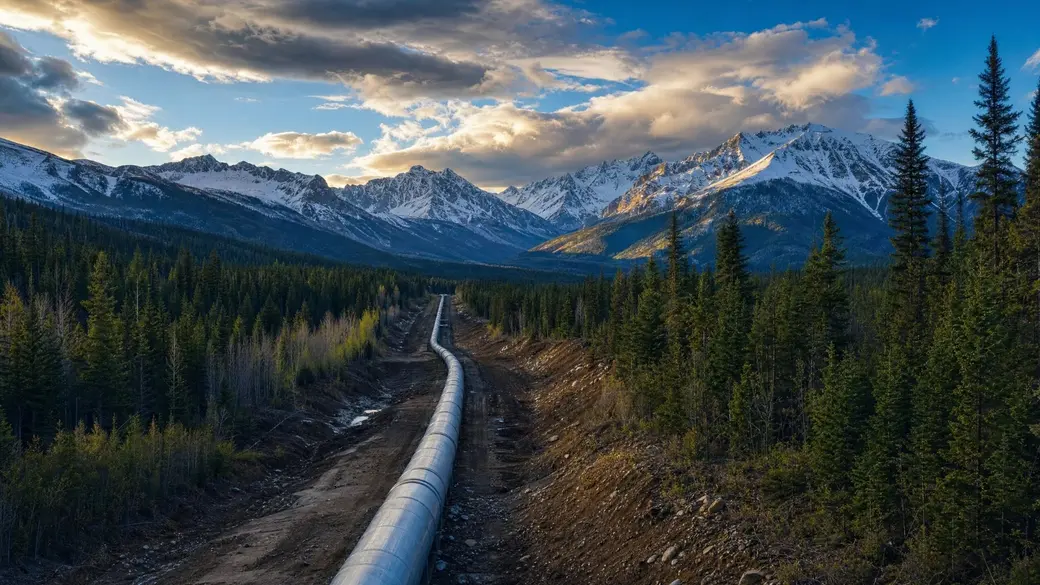
The Northern Gateway pipeline — a $7.9 billion project connecting Alberta's oilsands to a marine terminal at Kitimat — received regulatory approval in 2014 after an extensive Indigenous consultation process, with proponents reporting support from approximately 80% of First Nations communities along its proposed route. It was cancelled by the federal government in 2016. The projected lifetime economic activity was estimated at $300 billion, according to industry projections cited by Canada Action, a pro-development advocacy organisation. The Canadian Energy Centre — a Crown corporation funded by the Alberta government — estimated BC alone lost nearly 8,000 jobs per year, or approximately 224,000 jobs over 29 years, and more than $11 billion in provincial revenues from 2019 to 2048 as a result of the cancellation.
It is worth noting that a significant portion of the Indigenous communities along the proposed route were equity partners in the project. The National Coalition of Chiefs — representing pro-development First Nations leadership — has since called for the tanker ban that contributed to Northern Gateway's cancellation to be repealed, stating: "We want projects, not lawsuits. Communities don't need a cheque or a handout."
LNG Projects — A Long List of Departures
BC's LNG story is a catalogue of near-misses spanning more than a decade. Pacific NorthWest LNG — a $36 billion Petronas-led project near Prince Rupert capable of producing 20.5 million tonnes per year — was cancelled in 2017 after years of regulatory delays. Kitimat LNG, backed by Australia's Woodside, was abandoned after hundreds of millions spent in development costs; Woodside subsequently signed long-term LNG supply deals with China instead. New Times Energy's Prince Rupert terminal received federal export approval in 2016 and has not been heard from since. Canada Stewart Energy Group, Watson Island LNG, Kitsault Energy — a long list of projects that spent years and hundreds of millions of dollars in development before concluding that Canada's regulatory environment made them unviable.
Germany's Chancellor visited Canada seeking LNG supply agreements. Japan's Prime Minister made a similar request. Both subsequently signed long-term supply agreements with other producers, including the United States and Qatar, without securing Canadian LNG commitments.
When Canada declines to supply LNG to Germany, Japan, or Greece, the global demand for LNG does not disappear. Those countries sign supply agreements with other producers — predominantly the United States and Qatar. The economic activity, the royalties, the employment, and the export revenue that could have accrued to BC and Canada accrues instead to those jurisdictions. The resource market does not wait. It finds another supplier.
The Tanker Moratorium and Northern Coast Access
Bill C-48 — the federal oil tanker moratorium covering BC's northern coast — effectively blocked any pipeline project terminating at northern BC ports from reaching Asian markets. It was a legislative instrument that made the economics of any northern BC pipeline unworkable for private sector proponents, regardless of the regulatory outcome of any individual project assessment. The moratorium is now under active reconsideration as part of the Canada-Alberta Implementation Agreement signed in May 2026, which commits to pursuing its removal as a condition of the new west coast pipeline proceeding.
The New Pipeline — What Has Changed and What Has Not
The Canada-Alberta Implementation Agreement of May 2026 is a significant shift in federal posture toward BC resource development. Alberta is to submit a formal proposal to the Major Projects Office by July 1, 2026. The federal government has committed to pursuing national interest designation by October 1, 2026, with construction potentially commencing as early as September 2027. Oil could begin flowing to Asian markets around 2033 or 2034, according to provincial officials.
CIBC World Markets analysts characterised this timeline as "optimistic and reflective of a best-case scenario" — a characterisation worth taking seriously given that the Trans Mountain Expansion, the last major BC pipeline project, was originally projected to cost $5.4 billion and ultimately cost $34.2 billion, with Canadian taxpayers potentially subsidising oil shipments by between $8.7 billion and $18.8 billion over the project's life.
What Has Changed
- Federal government has formally committed to national interest designation process
- Canada-Alberta Implementation Agreement signed May 2026 sets clear timelines
- Trans Mountain operating and approaching capacity — providing evidence for the market case for additional Pacific export routes
- LNG Canada Phase 1 operational, exporting to Asian markets since mid-2025 — proving the BC-to-Asia supply chain works
- Western Canadian Critical Minerals Strategy MOU signed by BC, Alberta, and five other western provinces and territories — January 2026
- BC holds 4 of 15 federally fast-tracked projects including LNG Canada Phase 2 and Red Chris Mine Expansion
What Has Not Changed
- No private sector proponent has yet committed capital to the new pipeline
- The oil tanker moratorium on BC's northern coast remains in place pending negotiations
- BC Premier Eby has not reversed his opposition to the project
- Coastal First Nations opposition remains firm and legally consequential
- The Pathways carbon capture project — a precondition for the pipeline under the federal-Alberta agreement — has not secured final investment decisions
- Cost overrun risk on major Canadian infrastructure is well-documented
The honest assessment is that the pipeline represents a real shift in federal direction, genuine economic logic, and a legitimate nation-building opportunity — alongside real execution risk, unresolved Indigenous consultation obligations, and a regulatory and cost history that warrants sober scrutiny. Both things are true simultaneously.
The Real Housing Affordability Story Nobody Is Telling
Here is the connection that most BC real estate commentary misses entirely.
The housing affordability crisis in BC is almost universally discussed in terms of supply, zoning, interest rates, and speculation taxes. These are real factors. But they are symptoms of a deeper structural problem: BC has built an economy that is heavily dependent on real estate as a wealth creation vehicle precisely because it has systematically suppressed the development of the resource industries that would generate diversified, durable economic wealth.
When a province does not build pipelines, does not develop its mineral resources at scale, does not capture meaningful royalties from the LNG it does export, and does not build the infrastructure to connect its natural wealth to global markets — it still needs wealth. And in BC, that wealth has come primarily from housing appreciation. Real estate became the dominant investment vehicle not despite government policy but, at least in part, because of it. When productive economic alternatives face prolonged regulatory uncertainty, capital tends to concentrate in the assets that remain available — and in BC, residential real estate was one of the few that consistently delivered returns.
As a REALTOR® operating in West Vancouver, North Vancouver, and the Sea-to-Sky corridor for nearly four decades, I have a direct interest in property values and a professional obligation to my clients. But I also have a long enough view of this market to say clearly: a BC economy built primarily on housing appreciation is not a sustainable foundation. It prices out the workforce that runs the province, hollows out the middle class, and makes every subsequent generation more dependent on inherited wealth rather than earned income.
The pipeline, the critical minerals corridor, the LNG export capacity — these are not alternatives to a healthy housing market. They are the economic foundation that would make a healthy housing market possible. They generate the income, the government revenues, and the diversified employment base that allows a housing market to function at sustainable price-to-income ratios rather than the ratios we currently see in Metro Vancouver, which are among the most extreme on earth.
What This Means If You Own Property in BC
This is not an abstract policy discussion for property owners on the North Shore and Sea-to-Sky. The economic trajectory of this province directly shapes the long-term demand fundamentals for BC real estate.
The optimistic scenario: the pipeline proceeds, the critical minerals corridor develops, LNG exports grow, BC captures meaningful royalties and invests them in infrastructure and services rather than solely in deficit reduction. The result over a 10 to 15 year horizon is a more economically diversified province with a stronger employment base outside Metro Vancouver, better public services, and a housing market that is expensive because the underlying economy is genuinely wealthy rather than because capital has nowhere else to go.
The pessimistic scenario: the pipeline stalls again, the critical minerals opportunity is captured by other jurisdictions, LNG development remains constrained, and BC continues to fund operating deficits through borrowing while real estate remains the primary vehicle for household wealth creation. The housing market stays structurally expensive, the workforce continues to be priced out, and the province's ability to fund the infrastructure and services that make it liveable gradually deteriorates.
A resource-active BC economy does not threaten North Shore or Sea-to-Sky property values — it underpins them. The workforce that supports construction, the professionals who service the resource sector, the engineering and logistics firms that manage major infrastructure projects — they live somewhere. LNG Canada Phase 1's construction workforce created measurable housing demand pressure in the Squamish corridor. A pipeline build would do the same. More broadly, a BC government with resource revenues rather than deficits invests in the schools, hospitals, transit, and community infrastructure that make West Vancouver and the North Shore the places their residents chose them to be. The connection between resource wealth and residential real estate quality is direct, even if it is rarely discussed in those terms.
A Personal Note on the Debate
I am aware that stating a position on resource development in Metro Vancouver is not without social risk. This is a community with strong environmental values, and those values are genuine and worth respecting. The question of how BC develops its resources — what environmental standards apply, what Indigenous consent processes look like, what royalty structures ensure public capture of value — are legitimate and important questions that deserve serious answers, not dismissal.
But there is a meaningful difference between asking how BC develops its resources and whether it does. The "whether" question has, in my view, been answered badly for the past decade — not because BC chose environmental protection over economic development, but because it chose regulatory paralysis that delivered neither. Projects stalled for years, with proponents spending hundreds of millions in development costs before concluding the regulatory environment was too uncertain to proceed. In several cases — most notably Woodside's pivot to China and the LNG agreements signed by Germany and Japan with other suppliers — the demand was met by other producers. The environmental argument for developing Canadian LNG over alternatives with weaker environmental and labour standards has been made by several credible analysts, though it remains a contested position.
Norway developed its oil sector aggressively, captured the value rigorously, and used it to build one of the world's most comprehensive social welfare systems. It did not have to choose between prosperity and values. It chose to do both — carefully, with strong institutions, and with long-term thinking. That is the model worth considering. Not paralysis, and not uncritical extraction. Deliberate, well-governed development of BC's natural wealth in the interest of the public that owns it.
Frequently Asked Questions
Is BC actually resource-rich enough to matter on a global scale?
Yes, measurably so. BC holds 19 of Canada's 34 designated critical minerals. The province's LNG Canada facility shipped its first cargo to Asian markets in mid-2025, demonstrating the supply chain works. The Red Chris copper-gold mine expansion alone — one of BC's four federally fast-tracked projects — is projected to increase Canada's annual copper production by more than 15%. BC's hydroelectric system produces more clean power than the province currently consumes. By any objective measure, the asset base is significant.
Doesn't resource development harm BC's environment and therefore its real estate values?
This is the right question to ask, and it deserves a careful answer. The research on pipeline spills and property values does show localised impacts in affected areas. However, the broader argument — that resource development broadly depresses BC real estate values — is not supported by evidence. Alberta, which has developed its resource sector extensively, has among the strongest residential real estate markets in Canada outside Metro Vancouver. Norway, with an oil sector larger relative to GDP than Alberta's, has a highly functional housing market. What harms real estate values is economic stagnation, declining public services, and population outflow — outcomes more consistent with the scenario where BC does not develop its resource base than the scenario where it does.
What about Indigenous rights and consent? Doesn't that make BC resource development impossible?
No, and the evidence is against that framing. LNG Canada — now operational — was built with significant First Nations support and partnership along its route. Cedar LNG, currently in development at Kitimat, is 50.1% owned by the Haisla Nation. The Western Canadian Critical Minerals Strategy MOU signed in January 2026 was specifically framed around Indigenous co-ownership and economic partnership. The National Coalition of Chiefs has actively called for the repeal of the tanker moratorium. The narrative that Indigenous rights and resource development are necessarily opposed is factually incorrect — what is required is genuine early engagement, equity participation, and benefit-sharing. Projects that have done this well have proceeded. Projects that treated consultation as a box-ticking exercise have faced legal challenges. The lesson is not to avoid development. It is to do it properly from the beginning.
How does the new west coast pipeline affect BC real estate specifically?
Directly, a pipeline construction project of this scale creates significant workforce housing demand in the communities along its route and at its marine terminal — similar to the demand pattern seen in the Squamish and Kitimat corridors during LNG Canada construction. Indirectly and over a longer horizon, a pipeline generating meaningful BC royalty revenue changes the fiscal position of the provincial government — more revenue available for infrastructure, transit, healthcare, and the services that make communities function well. For North Shore and Sea-to-Sky property owners, the relevant question is whether BC's broader economic trajectory supports or undermines the desirability and liveability of these communities over the next decade.
Why is BC running a $10.9 billion deficit if it has all these resources?
In part because BC has not developed its resource base at a scale that generates royalty revenues comparable to its endowment. BC's resource royalties are a fraction of what they could be relative to the province's resource endowment. The province has historically relied on real estate transaction taxes — property transfer tax, speculation tax, foreign buyer tax — and income taxes as its primary revenue base, both of which are sensitive to economic cycles. A resource sector generating Norway-scale royalties would fundamentally change the provincial fiscal picture — but that requires making different decisions about which projects proceed, on what timeline, and with what royalty structures. Those decisions have not been made consistently or strategically over the past decade.
As a homeowner in BC, should I care about this?
Yes — for two reasons. First, the fiscal health of the provincial government directly affects the quality of the schools, hospitals, transit systems, and public infrastructure that make your community liveable and your property valuable. A province that cannot fund these services adequately is a less desirable place to live, regardless of what your assessment notice says. Second, the long-term demand fundamentals for BC real estate are tied to the province's economic vitality. A BC that generates real resource wealth, employs a well-paid workforce outside the service and real estate sectors, and attracts investment in productive industries is a BC where housing demand is supported by economic substance rather than by capital with nowhere else to go. The two things are connected.
Sources & References
- Province of British Columbia — "BC's 19 Critical Minerals and Western Canadian Critical Minerals Strategy MOU," January 2026. news.gov.bc.ca
- Natural Resources Canada — "Government of Canada invests to unlock Canada's critical minerals advantage," March 3, 2026. $3.6B in programs announced at PDAC. canada.ca
- Prime Minister of Canada — "Canada and Alberta Implementation Agreement — West Coast Pipeline," May 15, 2026. pm.gc.ca
- Alberta Government — "West Coast Oil Pipeline — Implementation Agreement Framework," May 2026. alberta.ca
- CBC News — "Alberta's timeline for West Coast pipeline 'best-case scenario': CIBC analysts," May 19, 2026. cbc.ca
- Fraser Institute — "BC would benefit from new pipeline but bad policy stands in the way," October 2025. Includes Canadian Energy Centre estimate of 224,000 lost jobs and $11B in lost BC revenues from Northern Gateway cancellation. fraserinstitute.org
- Canada Action — "Why Was the Northern Gateway Pipeline Cancelled?" — $300B lifetime economic activity projection, regulatory history, Indigenous support data. canadaaction.ca
- Canada Action — "Then & Now: What Happens When Canada Misses Out on Natural Resource Investment" — $670B in cancelled/abandoned Canadian resource projects. canadaaction.ca
- Canadian Energy Centre — "Indigenous communities shut out by BC tanker ban want another chance," February 2026. National Coalition of Chiefs position on tanker moratorium. canadianenergycentre.ca
- The Tyee / Mitchell Anderson — Norway vs. Alberta royalty per barrel comparison: Norway $87.69, Alberta $4.38 (2013 data). Referenced in The Narwhal, "How Useful is the Norway vs. Alberta Comparison?" thenarwhal.ca
- Rowanwood Chronicles / McGill Journal of Economics — Norway Government Pension Fund Global: $1.5 trillion USD. Alberta Heritage Savings Trust Fund: $31.5 billion CAD (September 2025). Analysis of governance and royalty structure differences.
- Resource Works — "Billions lost in ditched resource projects" — LNG project cancellation catalogue including Pacific NorthWest LNG, Kitimat LNG (Woodside), New Times Energy, and others. resourceworks.com
- TD Economics — "Provincial Economic Forecast," 2026. BC economic outlook, LNG Canada Phase 1 export data, pipeline timeline analysis. economics.td.com
- Province of British Columbia — "Delivering Major Projects Faster" — BC's four federally fast-tracked projects, North Coast Transmission Line, critical minerals corridor. gov.bc.ca
- Daily Hive / Urbanized — BC provincial deficit at all-time high of $10.9 billion for 2025/26. TransLink $600M operating deficit. Canada Public Transit Fund reduced by $5B under Carney government.
- International Institute for Sustainable Development (IISD) — Trans Mountain Expansion cost overrun: $5.4B forecast vs. $34.2B actual. Taxpayer subsidy estimate: $8.7B to $18.8B over project life. iisd.org
- SnapStats® / Greater Vancouver REALTORS® — West Vancouver and North Shore market data, YTD May 2026.
Debbie Evans | REALTOR® & Registered Interior Designer
eXp Realty | West Vancouver · North Shore · Sea-to-Sky
Nearly 40 years of combined real estate and design experience across West Vancouver, the North Shore, and the Sea-to-Sky corridor. My practice is built on helping clients understand the full picture — market conditions, policy implications, economic context — so they can make decisions grounded in evidence rather than headlines. If you want to talk about what BC's economic trajectory means for your property, your portfolio, or your next move, that conversation starts at the link below.
westvanliving.ca · debbie.evans@exprealty.com
This article reflects the views and analysis of the author based on publicly available sources as referenced. It does not constitute financial, legal, or investment advice. Market data referenced is sourced from SnapStats® / Greater Vancouver REALTORS® MLS data through May 2026. Economic projections and resource development figures are drawn from the cited sources and should be independently verified before being relied upon. Several figures cited — including the $670 billion and $300 billion estimates — originate from industry and advocacy organisations as noted; they represent projected values, not independently audited outcomes. The views expressed on resource development policy represent the author's informed perspective as a long-term BC real estate professional and are intended to contribute to public economic discussion, not to advocate for any specific political party or candidate.
Categories
- All Blogs (98)
- aboriginal title ruling (2)
- bc housing market (23)
- bc real estate (56)
- Bill C-15 (1)
- build canada homes (8)
- Buyers Guide (4)
- canada strong fund (3)
- Canada-U.S. Trade (2)
- canadian real estate (15)
- Climate Change (2)
- Design & Build (4)
- Dundarave West Vancouver (1)
- Equity Growth (1)
- freehold (1)
- Home Buying Tips (1)
- housing policy (1)
- land claims (2)
- Land Claims / BC Real Estate (1)
- leasehold (1)
- local news (1)
- Lower Lonsdale (2)
- Market & Policy Analysis (1)
- Market Commentary (6)
- market insights (23)
- Multigenerational Living (2)
- North Vancouver Real Estate (19)
- open house (1)
- Open House Security (1)
- presale (1)
- real estate insights (7)
- Real Estate Market & Housing (2)
- renovation (1)
- Squamish Market Update (7)
- squamish real estate (8)
- squamish update (3)
- Vancouver Real Estate (17)
- West Vancouver Living (15)
- West Vancouver Real Estate (26)
- Whistler Market Update (4)
Recent Posts





Have a Question? Let’s Talk. I’m Here to Help.

North Shore & Vancouver Realtor License ID: 175378
+1(778) 875-4934 | debbie.evans@exprealty.com