
The $150,000 Construction Problem Nobody's Talking About | West Vancouver Living
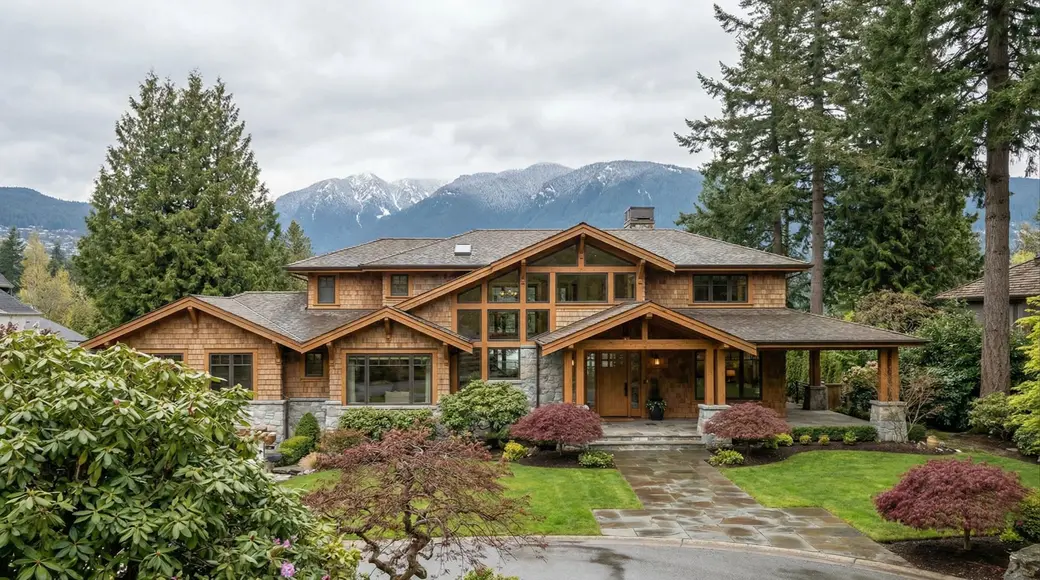
The $150,000 Construction Problem Nobody's Talking About
How can home prices soften while the cost to build a new home jumps by more than $150,000 in a single year? It sounds like a contradiction — but it's exactly what's happening in West Vancouver right now, and it has real implications for anyone trying to understand where this market is heading.
The Numbers Don't Add Up — On Purpose
The May 2026 SnapStats data for West Vancouver detached homes shows a median sale price of $2,750,000 — down from $3,015,583 in 2025 and well below the 11-year average of $2,882,021. The year-to-date median sits at $2,947,000. By most surface readings, the market has softened.
Now consider what it actually costs to build a new detached home here today.
| Cost Component | Estimated Range |
|---|---|
| Land acquisition (West Van detached lot) | $1,800,000 – $2,500,000+ |
| Demolition, permits & site preparation | $80,000 – $150,000 |
| Construction (3,500–5,000 sq.ft. at $600–$900/sq.ft.) | $2,100,000 – $4,500,000 |
| Landscaping, appliances, soft costs | $150,000 – $350,000 |
| Estimated All-In Replacement Cost | $4,130,000 – $7,500,000+ |
Even at the conservative end of that range, the gap between what a finished home sells for and what it costs to build one is significant — and in many cases, it exceeds $1,000,000 or more. That gap is not a market anomaly. It is a structural feature of a land-constrained market where construction input costs have risen sharply.
What Does a $150,000 Jump in One Year Actually Mean?
Construction cost escalation has been a persistent story across BC since 2020, but the pace has not been uniform. Industry sources cite material costs, skilled labour shortages, extended permitting timelines, and the ripple effects of large infrastructure projects competing for the same trade contractors as compounding pressures. In practical terms, a project that was budgeted at a certain figure 12 to 18 months ago can arrive at tender with costs materially higher — in some documented cases, exceeding the prior budget by $150,000 or more on a typical single-family project.
That number matters because it shifts the feasibility calculation for builders, developers, and homeowners simultaneously.
When construction costs rise faster than resale values, three groups feel it: developers who can no longer underwrite new builds profitably; homeowners who want to renovate but face higher contractor quotes; and buyers who might have considered a teardown-and-rebuild strategy but now find it financially unworkable at current land prices. All three effects reduce the supply of new housing in the market.
Why Developers Stop Building — And What Happens Next
The logic is straightforward: no rational developer will spend $4.5 million to build a home the market values at $2.9 million. When the cost to build exceeds the resale value, new construction effectively pauses. That is not speculation — it is how feasibility works in any development market.
The consequence is a reduction in new supply entering the market, which tends to place a floor under existing home values over time. West Vancouver's SnapStats data reflects this dynamic: despite benchmark price softening at the median level, the market is running at a buyer's market sales ratio of 8% year-to-date in 2026 — not a collapse, but a measured correction in a market where supply and new development are both constrained.
For buyers considering new construction, the math means that a quality existing home — particularly one that was built in the last 5 to 10 years — may represent genuine value relative to the cost of building the same thing today. This is the replacement cost argument, and it is one of the more defensible long-term value propositions in a softening market.
The Reluctant Seller Problem
Replacement cost doesn't only affect the supply side of new construction. It affects the decision of existing homeowners to sell at all.
Consider a homeowner who purchased and renovated a West Vancouver property over the last 10 to 15 years. To sell and replace their home with something comparable — same neighbourhood, same quality of finish, same square footage — requires accessing the same construction market that is pricing out developers. For many, the calculus no longer favours a move.
Reasons to Stay
- Replacement cost of comparable home exceeds sale proceeds
- Existing mortgage rate is below current rates
- Renovation of current home is less disruptive than a move
- Strong emotional and community attachment to neighbourhood
Reasons to Sell
- Life stage change (downsizing, estate, relocation)
- Equity capture before any further price correction
- Maintenance burden of a large home increasing
- Favourable buyer profile for their price point exists
The result of this hesitation is a persistently low supply of quality resale homes in the $3M–$4.5M range — a range where the West Vancouver market has historically been most liquid. When motivated sellers are fewer, transaction volume suffers even without a sharp price move in either direction. The SnapStats data confirms this: West Vancouver detached sales totalled just 27 units in the first five months of 2026 — a pace that, if sustained, would represent one of the quieter years on record for the district.
The Geographic Constraint That Amplifies Everything
Every factor described above is amplified by one irreducible reality: West Vancouver has essentially no land left to develop in the conventional sense. The mountains are to the north. The ocean is to the south. The District's boundaries are fixed. The supply of developable lots is, for practical purposes, finite.
That constraint doesn't mean prices can only go up. Markets soften for many reasons — interest rates, employment, buyer sentiment, and global capital flows all play a role. But land scarcity does mean that the supply response to demand is structurally limited. When demand recovers — as it typically does in markets with genuine geographic and regulatory constraints — the supply side cannot respond quickly. New homes take two to four years to design, permit, and build, even in a favourable cost environment.
The same dynamic appears across the North Shore luxury detached market. Recently completed custom homes are trading at prices that fall materially below what a buyer would spend to acquire equivalent land and replicate the build today. At current construction costs of $600–$900 per square foot, the total investment in a quality custom build on the North Shore can easily exceed what the resale market will currently support — creating a genuine below-replacement-cost opportunity for buyers who understand the numbers and have a medium to long-term horizon.
Replacement Cost as a Price Floor: What the History Suggests
Replacement cost is not a guarantee of price appreciation, and it should not be interpreted as one. Markets can remain below replacement cost for extended periods, particularly when financing costs are high, buyer confidence is weak, or inventory levels are elevated. While those factors influence short-term pricing, replacement cost remains an important consideration when evaluating long-term market resilience.
The replacement cost framework offers a different way of looking at value. If the total cost to acquire land, demolish an existing home, obtain permits, finance the project, and build a comparable luxury residence exceeds what similar homes are currently selling for, the economics of rebuilding become increasingly difficult to justify. That can discourage new construction and limit future housing supply.
It’s also important to recognise that replacement costs vary significantly depending on who is building and how. An experienced builder constructing their own home can often achieve a lower all-in cost by eliminating general contractor markup, leveraging direct trade relationships, and carrying no profit margin on the build. That is a different number from what a typical buyer, developer, or homeowner would spend hiring a general contractor, project consultants, and trades at full retail market rates — where every layer of the supply chain is priced accordingly. The $600–$900 per square foot range used in this analysis reflects the retail construction market, not owner-builder economics. What matters for replacement cost as a valuation concept is what it would cost the next person to replicate the home — and for most buyers, that means the retail rate, not the owner-builder rate.
Over the long term, market value and replacement cost often move closer together, whether through changes in resale prices, construction costs, or a combination of both. While no one can predict exactly when or how that adjustment will occur, replacement cost remains an important factor in understanding long-term housing economics.
Replacement cost is one input in a complex pricing equation, not a floor that prevents further price softening. Buyers should consider current market conditions, financing costs, their own timeline, and professional advice before drawing conclusions from any single valuation framework. No one — including any market analyst or REALTOR® — can reliably predict where prices will go in the short term.
What This Means Practically — For Buyers, Sellers, and Owners
If You Are Considering Buying
The replacement cost gap provides a rational framework for evaluating existing homes relative to new construction. A well-maintained or recently renovated West Vancouver home acquired below its replacement cost is not the same purchase as one acquired above it. That framing doesn't replace a thorough CMA, property inspection, and financing analysis — but it adds a dimension that pure comparables-based analysis can miss.
From a design perspective: homes that were built or significantly renovated in the last five to eight years often have the systems, envelope performance, and finish standards that buyers would otherwise have to build into a new construction budget. The cost of achieving those specifications is already embedded in a quality resale home — at today's market prices, not today's construction prices.
If You Are Considering Selling
The replacement cost argument can work in your favour in listing marketing — but only if the property genuinely supports it. A home with a credible all-in construction value materially above its list price has a legitimate "below replacement cost" story to tell. That narrative needs to be backed by specific numbers, not marketing language.
Conversely, sellers who are hesitating because the cost of replacing their home feels prohibitive should think carefully about whether that hesitation is protecting them or costing them. In a balanced-to-buyer's market with 37 days average DOM, the cost of not selling — carrying costs, opportunity cost, life stage considerations — deserves equal weight alongside the cost of replacing the home.
If You Are Planning a Renovation
The same cost escalation affecting new construction is affecting renovation budgets. Scope definition, contractor selection, and phased planning matter more than ever. An investment in a well-specified renovation on a property you already own is often a more efficient use of capital than acquiring a new home at today's land prices — but the numbers need to be modelled honestly, not estimated loosely.
Frequently Asked Questions
Why are West Vancouver home prices softening if replacement cost is so high?
Replacement cost is a long-term value consideration, not a short-term price floor. In the near term, prices respond to interest rates, buyer sentiment, inventory levels, and transaction volume. The current softening reflects a correction from the 2021–2022 peak in a higher-rate environment, not a fundamental change in land scarcity or construction economics. Both things can be true simultaneously.
Does construction cost escalation affect all homes equally?
No. It has the greatest impact on properties where the land value is a smaller proportion of the total value — typically mid-range and older homes where a buyer might consider a teardown-and-rebuild strategy. For high-end properties where land itself is a dominant value driver, the construction cost argument is somewhat different in character.
What does $600–$900 per square foot actually get you?
The range reflects significant variation in specification. At $600/sq.ft., a builder can produce a well-constructed home with standard finishes, adequate mechanical systems, and code-compliant performance. At $900/sq.ft. and above, the specification typically includes premium millwork, high-end appliance packages, engineered mechanical systems, rain screen envelopes, smart home integration, and the kind of finish quality that buyers in the West Vancouver luxury market expect. Very high-specification custom homes can exceed $1,000/sq.ft. on total construction cost.
Is this the right time to buy in West Vancouver?
That depends entirely on your financial position, timeline, and objectives — and I won't pretend otherwise. What I can say is that a market where benchmark prices have softened to around $2.75M–$2.95M, construction costs have risen, and new supply is constrained is structurally different from a market where all three of those conditions are working against a buyer. Whether those conditions translate into a compelling purchase for your specific circumstances requires a detailed, personalised analysis.
How does the design side of the equation factor into this?
More than most buyers realise. The cost to achieve a specific outcome — functional floor plan, quality of light, storage configuration, material specification — is built into the construction budget. Buying an existing home that already has those outcomes locks in value that would cost materially more to create from scratch today. As a Registered Interior Designer, that is one of the assessments I bring to property evaluations that a comparables-only analysis does not capture.
About the Author
Debbie Evans is a REALTOR® with eXp Realty and a Registered Interior Designer (RID CNE) with nearly 40 years of combined experience in real estate, interior design, construction, and renovation. She serves buyers and sellers across West Vancouver, North Vancouver, and the Sea-to-Sky corridor through the West Vancouver Living platform.
Debbie's dual professional background informs market analysis and property evaluations that go beyond comparables — assessing renovation potential, specification quality, design efficiency, and the true cost implications of any purchase or improvement decision.
westvanliving.ca · eXp Realty
SnapStats® West Vancouver Detached — May 2026 YTD. Data sourced from Greater Vancouver REALTORS® MLS database. All data reported is median.
SnapStats® North Vancouver Detached — May 2026 YTD.
Construction cost per square foot ranges are consistent with industry estimates reported by BC-based general contractors and quantity surveyors, and with data from Altus Group's Canadian Construction Cost Guide (2025–2026).
Replacement cost observations are consistent with professional market experience across West Vancouver and North Shore detached properties, 2025–2026, cross-referenced against publicly available construction cost data.
The accuracy and completeness of MLS data is not guaranteed. Construction cost estimates are illustrative ranges only and will vary significantly by project scope, specification, site conditions, contractor, and timing. This post is for informational purposes. It does not constitute financial, legal, or investment advice. Readers should consult qualified professionals before making real estate or construction decisions.
Debbie Evans is a licensed REALTOR® with eXp Realty (RECBC) and a Registered Interior Designer (IDIBC). Real estate and interior design services are provided under separate professional licences. This content has been prepared for general educational and informational purposes. It is not intended as a solicitation for any specific property or client relationship.
Categories
- All Blogs (102)
- aboriginal title ruling (2)
- B.C. Policy (1)
- bc housing market (23)
- bc real estate (56)
- Bill C-15 (1)
- build canada homes (10)
- Buyers Guide (4)
- canada strong fund (4)
- Canada-U.S. Trade (2)
- canadian real estate (16)
- Canadian Real Estate & Housing (1)
- Climate Change (2)
- Cost of Living (2)
- Design & Build (4)
- Dundarave West Vancouver (1)
- Equity Growth (1)
- Federal Policy (1)
- freehold (1)
- Home Buying Tips (1)
- Household Debt (1)
- housing policy (1)
- land claims (2)
- Land Claims / BC Real Estate (1)
- leasehold (1)
- local news (1)
- Lower Lonsdale (2)
- Market & Policy Analysis (1)
- Market Commentary (6)
- market insights (23)
- Mortgage Delinquencies (1)
- Mortgage Renewals (1)
- Multigenerational Living (2)
- North Vancouver Real Estate (19)
- open house (1)
- Open House Security (1)
- presale (1)
- real estate insights (7)
- Real Estate Market & Housing (2)
- renovation (1)
- Squamish Market Update (7)
- squamish real estate (8)
- squamish update (3)
- Vancouver Real Estate (17)
- West Vancouver Living (15)
- West Vancouver Real Estate (26)
- Whistler Market Update (4)
Recent Posts





Have a Question? Let’s Talk. I’m Here to Help.

North Shore & Vancouver Realtor License ID: 175378
+1(778) 875-4934 | debbie.evans@exprealty.com