
Could Your Home Security Cameras Cost You a Sale?
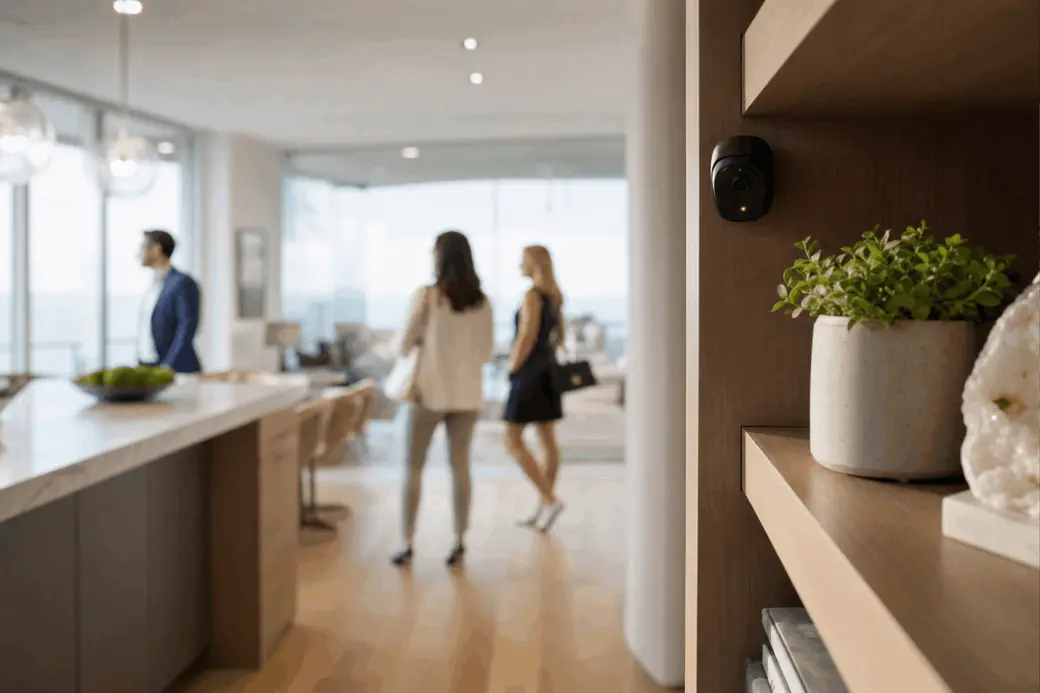
Could Your Home Security Cameras Cost You a Sale?
What Buyers, Sellers, and REALTORS® Need to Know About Audio and Video Recording During Open Houses
Ring doorbells. Nest cameras. Smart speakers. Baby monitors tucked into corners. Security systems that record continuously to the cloud. Most homeowners think of these as protection — and they are. But during an open house or showing, they become something else entirely: active recording devices capturing the conversations of people who may be your prospective buyers. In British Columbia, that distinction has legal weight, professional implications, and real potential to affect your transaction.
I recently created a short video series on this topic — because I've had enough client conversations about it to know the issue isn't well understood on any side of the transaction. Buyers don't realize their candid comments may be recorded. Sellers often haven't thought carefully about what their cameras are actually capturing. And some REALTORS® are navigating the issue without clear guidance from their brokerages.
This article is the longer version of that conversation. It draws directly on a May 2026 Legally Speaking bulletin from the British Columbia Real Estate Association (BCREA), written by Lisa Niro of Bell Alliance LLP, which addressed surveillance cameras and recording practices as part of a broader analysis of showings and open houses. I'll walk through what BC law says, what the practical risks are, and what each party — seller, buyer, and REALTOR® — should actually do.
A Perspective From Inside Private Homes
As a Registered Interior Designer who has spent nearly four decades working inside private homes, renovation projects, luxury residences, vacation properties, and estate homes, I have watched residential security technology evolve dramatically.
In my interior design practice, I have had homeowners contact me while I was actively working inside their home on a renovation or design project — not because something was wrong, but because they were watching remotely through their security systems. They could see which trades had arrived, monitor project progress in real time, and observe activity throughout the home without being physically present.
Many homeowners can access live video feeds, security cameras, and smart home systems from anywhere in the world with a smartphone. These systems are typically installed for security and peace of mind. The point isn't that homeowners are doing anything improper. The point is simply that modern residential technology is often far more sophisticated — and far more active — than many visitors realize.
In high-end homes particularly, technology is often integrated directly into the architecture. Cameras are recessed into millwork or ceiling coffers. Sensors are built into cabinetry. Smart home components are concealed behind panels. These systems are designed to blend into the home rather than announce themselves. A buyer walking through a beautifully finished property will not necessarily see every device that is operating.
That is the design perspective. The real estate perspective follows directly from it: if you are a buyer, a seller, or a REALTOR® inside a home that is for sale, you are almost certainly inside a home with active recording technology — whether you can see it or not.
Video Recording vs. Audio Recording: Why the Distinction Matters
Not all home security devices record the same thing, and the legal treatment of video versus audio recording is meaningfully different.
Video-Only Recording
- Captures visual movement and presence
- Common in outdoor cameras, entry cameras, and older systems
- Generally subject to civil privacy considerations, but treated differently than audio under the Criminal Code
- May be used as evidence in disciplinary proceedings — and has been
Audio Recording (or Combined A/V)
- Captures spoken conversations
- Modern Ring doorbells, Nest cams, smart speakers, and baby monitors typically capture audio automatically
- Raises separate legal considerations under the Criminal Code of Canada regarding interception of private communications
- Buyers and their agents may unknowingly disclose negotiating information
The BCREA bulletin is direct on this point: video surveillance and audio recording are not treated the same under the law, and REALTORS® should be especially cautious about on-site conversations near devices capable of capturing audio. Under the Criminal Code, intercepting a private communication can raise separate legal issues unless an exception applies — including consent from a party to the communication.
The challenge is that many homeowners don't know whether their devices record audio. The default setting on many modern cameras and smart speakers is audio-on. If you have a Ring doorbell, a Nest camera, an Amazon Echo, a Google Home, or a baby monitor in a room, there is a reasonable probability it is capturing audio by default.
This article provides general educational information and is not legal advice. BC privacy law involves multiple overlapping statutes — including the Personal Information Protection Act (PIPA), the Privacy Act, and the Criminal Code of Canada. If you have specific questions about recording practices and legal exposure, consult a lawyer. REALTORS® should seek guidance from their managing broker and brokerage legal counsel.
The BC Privacy Framework: PIPA, the Privacy Act, and the Criminal Code
British Columbia's private-sector privacy statute is the Personal Information Protection Act (PIPA). PIPA governs the collection, use, and disclosure of personal information by organizations in a manner that recognizes both privacy rights and organizations' legitimate need to collect information for purposes a reasonable person would consider appropriate.
PIPA generally applies to organizations — businesses and brokerages — rather than to purely personal or domestic conduct. There is a specific exception for personal information collected, used, or disclosed by an individual for personal or domestic purposes only. This means a homeowner's personal Ring doorbell may fall outside PIPA if used strictly for personal security.
However, as the BCREA bulletin notes, even where PIPA does not apply, surveillance and recording practices may still raise civil privacy issues under BC's Privacy Act. And audio recording of conversations — as noted above — engages the Criminal Code separately from PIPA.
If a brokerage or another organization is itself collecting or using surveillance footage in the course of business, PIPA is much more likely to apply. A listing agent who reviews a seller's security footage for business purposes, or a brokerage that installs cameras in a show suite or model home, would likely be subject to PIPA's requirements. This is a distinct situation from a homeowner's personal use of their own security system.
Why This Matters to Sellers
Most sellers who keep their cameras active during showings are thinking about security — protecting valuables, monitoring who enters, deterring theft. Those are legitimate concerns. But there are risks on the other side of that calculation that are worth understanding before the first showing takes place.
Risk 1 — Recording Buyer Conversations
If a buyer and their agent have a candid conversation inside your home — about offer strategy, budget limits, motivation to purchase, or concerns about the property — and your camera captures that audio, you have received information the buyer never intended to share with you. Even if you never use it, the existence of that recording creates potential legal exposure. If a buyer later discovers their private conversation was recorded, it could generate a privacy complaint, damage the transaction, or — in the right circumstances — attract regulatory scrutiny.
Risk 2 — Chilling the Sale Process
Buyers who become aware (or suspicious) that they are being recorded will behave differently. They may be less willing to ask questions, less likely to engage openly with your agent, and less inclined to make offers. An open house is meant to generate genuine interest and candid reactions. A surveillance environment can suppress exactly the kind of authentic buyer engagement that leads to offers.
Risk 3 — Unintended Disclosure
If your listing agent is aware of cameras and has not disclosed them to buyers' agents, this can become a professional issue. The BCREA bulletin notes that it is best practice for listing agents to communicate that cameras are present if they are aware of them and the seller has consented to such disclosure. Failing to address this proactively can create friction, complaints, and — in regulated contexts — disciplinary exposure for your agent.
Why This Matters to Buyers
Buyers are routinely candid inside properties they are touring. It is completely natural — and almost impossible to avoid — to react honestly to what you see, talk through what you might change, or discuss your offer thinking with your REALTOR® while standing in the kitchen or on the patio. That candour is part of how buyers process a decision. The problem is that it may not be as private as it feels.
To make that concrete: imagine standing in the kitchen during a showing and saying to your partner or REALTOR®, "I love this place," "We would probably pay another $50,000 if we had to," or "We really need to move before school starts." Now imagine the seller hearing that conversation later that evening on their phone.
Whether the recording was intentional, incidental, or even legally permissible is almost secondary at that point. The damage to your negotiating position may already be done. A seller who knows you have a hard deadline and emotional attachment to the property is not going to negotiate the same way as one who perceives a measured, patient buyer with options. In a market where tens of thousands of dollars can turn on the right offer, that information gap matters.
Any of these categories of conversation should be saved for outside the property:
- Your actual budget and maximum purchase price
- Offer strategy — where you plan to start, how high you would go
- Time pressures — lease end, school year, a competing offer deadline
- Emotional attachment — "I love this," "my spouse needs this one," "this is the one"
- Concerns about the property that you might use as negotiating leverage
- Renovation plans and how much you are prepared to spend
The Simplest Rule
Assume you are on camera — and potentially on audio — from the moment you walk up the driveway until the moment you leave the property.
If you are a buyer, save all discussions about price, budget, motivation, concerns, or negotiating strategy until you are back in your vehicle or speaking privately with your REALTOR®.
That single habit can protect information that may be worth thousands of dollars during a negotiation.
The BCREA bulletin specifically flags that less visible devices — including crib cameras and nanny cams — may be present in the home. These are small, easily concealed, and commonly capable of audio capture. A device on a bookshelf, in a plant, or mounted near an outlet may not be visible during a walkthrough. The safest assumption is that any room could have a recording device.
Why This Matters to REALTORS®
For REALTORS®, the issue sits at the intersection of client service, professional obligation, and regulatory risk. The BCREA bulletin makes clear that prudent REALTORS® should assume there may be surveillance devices in the home and conduct themselves accordingly — regardless of whether disclosure is legally required in every situation.
Protecting the Seller's Interests
If you are the listing agent, your obligation under section 30(a) of the Real Estate Services Rules is to act in the seller's best interests. Part of that obligation is advising the seller on practices — including recording — that could generate legal exposure or complicate the transaction. A seller who is unknowingly creating a privacy law issue, or who is capturing audio from buyer conversations in a way that could be challenged, needs to know before it becomes a problem.
Protecting the Buyer's Agent
If you are acting for buyers, the practical risk is that your clients' candid comments — or your own — are captured on a device you didn't know was active. The BCREA bulletin reinforces that the best practice is to avoid substantive or confidential conversations while inside the property, and instead wait until you have exited the home. This is a professional habit worth building regardless of the specific property.
Camera Footage in Regulatory Investigations
The BCREA bulletin includes a notable 2024 disciplinary case: a REALTOR® was ordered to pay a $10,000 discipline penalty and $4,000 in enforcement expenses after allowing clients to access a property without a licensed agent present, using an unlicensed person to show the property, and then providing false or misleading information to the BC Financial Services Authority (BCFSA). The seller, monitoring the property by surveillance camera, observed that the buyer's REALTOR® was not present during the showing. The REALTOR®'s misleading account was directly disproved by the footage.
Surveillance cameras are not passive. They create records, and those records can be reviewed — by sellers, by brokerages, and by regulators.
In a separate 2024 case referenced in the BCREA bulletin, a REALTOR® was fined $20,000 after being caught on camera consuming food from the seller's refrigerator during a showing. The BC Financial Services Authority concluded the conduct undermined public confidence in the real estate industry and constituted conduct unbecoming of a licensee. The fact that this occurred during the COVID-19 period was noted as an aggravating factor. The camera that caught it was the seller's personal security system.
Open House Best Practices: A Practical Checklist
The following checklist is drawn from the BCREA Legally Speaking bulletin and my own practice. It is designed to be practical rather than comprehensive — the kind of guidance you can apply before the next showing.
For Sellers
- Identify every recording device in your home — doorbells, cameras, smart speakers, baby monitors, and any device with a microphone
- Determine whether each device records audio, video, or both, and check your default settings
- Discuss your recording setup with your REALTOR® before any showings take place
- Consult your brokerage or a lawyer if you are uncertain about disclosure obligations or legal exposure
- Consider disabling audio capture (not necessarily video) on interior devices during showing periods — and document that decision
- Do not use recorded buyer conversations to inform your negotiating position without legal guidance
For Buyers
- Assume you may be on camera — and potentially on audio — from the moment you approach the property
- Save all negotiating conversations — offer numbers, budget limits, motivation, and concerns — for outside the property
- Debrief with your REALTOR® in your car, on a walk, or back at the office — not in the seller's kitchen
- Be aware that less visible devices (nanny cams, small shelf cameras) may not be obvious during a walkthrough
- Ask your REALTOR® whether they are aware of any disclosed recording devices at the property
For REALTORS®
- Assume surveillance devices may be present in any property, whether or not they are visible
- Brief your buyer clients before entering any property to reserve negotiations for outside
- If you are the listing agent, discuss the seller's recording setup early — before showings begin — and advise on best practices and disclosure
- Follow your brokerage's policies on recording disclosure and document your conversations with the seller on this topic
- Conduct yourself as if you are on camera at all times inside a listed property — because you may be
- Seek current guidance from your managing broker on how your brokerage handles disclosure of known recording devices
A Note on My Video Series
I recently produced a short series of videos walking through the open house recording issue in more accessible terms — covering how common devices actually work, what buyers and sellers most often get wrong, and how what seems like a minor technology decision can quietly affect negotiations. If you prefer to watch rather than read, I'd encourage you to search for that content on my YouTube channel or reach out directly and I'll send you the links.
The reason I created both the video series and this longer article is the same: this is a topic that affects almost every transaction in some form now, and the information most people have is either too vague to be useful or too legalistic to be actionable. My goal is to close that gap.
Frequently Asked Questions
Can a seller legally record visitors during an open house in BC?
Video recording for personal security purposes by an individual homeowner may fall outside the scope of BC's Personal Information Protection Act (PIPA) if conducted strictly for personal or domestic purposes. However, audio recording of private conversations raises separate considerations under BC's Privacy Act and the Criminal Code of Canada. The legal picture is nuanced and fact-specific — sellers who are uncertain should consult a lawyer before assuming their recording practices are unambiguously permissible.
Is a seller required to disclose that cameras are recording during a showing?
The BCREA Legally Speaking bulletin (May 2026) describes disclosure as best practice rather than a universal legal requirement in every situation: it recommends listing agents communicate that cameras are present if they are aware of them and the seller has consented to disclosure. Regardless of whether disclosure is legally compelled in a specific scenario, the prudent approach — and the one that protects all parties — is to disclose known recording devices proactively. Regulatory best practice and legal obligation are not always the same thing, and the gap between them is where problems arise.
What is the difference between PIPA and the BC Privacy Act?
PIPA (the Personal Information Protection Act) is BC's private-sector privacy statute governing how organizations collect, use, and disclose personal information. It applies primarily to businesses and organizations, not to individuals acting in a personal capacity. The BC Privacy Act is a separate statute that creates a civil cause of action for individuals whose privacy is violated — it can apply to individual conduct as well as organizational conduct. Both are relevant to real estate recording scenarios, though in different ways and with different remedies.
Does a smart speaker like an Amazon Echo or Google Home record conversations?
Smart speakers are designed to listen continuously for their wake word (e.g., "Alexa" or "Hey Google") and may capture audio inadvertently before or after a wake event. They store voice recordings in associated cloud accounts. Whether they are actively recording in a legally meaningful sense depends on their settings and the specific activation event — but for practical purposes, any smart speaker in a room should be treated as a potential audio-capture device during a showing. The safest approach for sellers is to unplug or mute smart speakers during open houses and showings.
If a seller hears a buyer's negotiating conversation on their camera footage, can they use it?
This is precisely where the legal risk concentrates. Using improperly captured audio of a private negotiating conversation — even if the recording itself was incidental — could attract civil liability under BC's Privacy Act, and potentially raise issues under the Criminal Code if the audio constitutes an intercepted private communication. Any seller who finds themselves in this situation should consult a lawyer before taking any action based on what they heard. It is also the kind of issue that, if it surfaces, can derail or invalidate a transaction.
Should buyers ask their REALTOR® to check for recording devices before touring a property?
Buyers can ask their REALTOR® whether any recording devices have been disclosed by the listing agent. What buyers cannot assume is that disclosure is complete — less visible devices (nanny cams, small shelf cameras, devices in smoke detector housings) may not be noted or even known to the listing agent. The more reliable approach is simply to operate on the assumption that any property may have active recording devices, and govern your conversations accordingly. This is not paranoia — it is a practical response to a real and common situation.
What should REALTORS® do if they discover an undisclosed recording device during a showing?
If a buyer's REALTOR® discovers or suspects an undisclosed recording device, the appropriate first step is to immediately stop any confidential conversations inside the property and move the discussion outside. The discovering agent should make note of what they observed and report it to their managing broker for guidance on next steps. Whether and how to raise it with the listing agent or brokerage is a matter for broker guidance, as it depends on the specific circumstances and any applicable brokerage policy.
The question is not simply whether a camera exists. The real question is whether recording practices — knowingly or unknowingly — could expose information that affects a buyer's negotiating position, create legal exposure for a seller, or put a REALTOR®'s professional standing at risk. A security system that records video of who enters your home is a reasonable precaution. A system that captures your buyer's negotiating strategy and budget in audio is something different entirely.
The question is no longer whether recording technology exists in homes. It does — in nearly every home in the markets where I work. The question is whether buyers, sellers, and REALTORS® understand how common it has become and how quietly it operates.
As someone who has spent nearly four decades inside private homes through both real estate and interior design, I can say with confidence that residential technology has advanced far faster than most people's understanding of the privacy implications. The gap between what a home can record and what visitors assume about their privacy is real, and it closes at the buyer's expense when it goes unaddressed.
The safest approach is also the simplest: assume you are being observed. Conduct yourself professionally. Save confidential conversations for private settings. That habit costs nothing and protects a great deal.
Debbie Evans is a REALTOR® and Registered Interior Designer with eXp Realty, serving West Vancouver, North Vancouver, Vancouver, Squamish, and Whistler. She holds the CNE designation and brings nearly 40 years of combined experience in real estate, interior design, construction, and renovation. For a consultation or to discuss a property, visit westvanliving.ca.
BCREA — Legally Speaking #596: Best Practices for Showings and Open Houses
Lisa Niro, Bell Alliance LLP — May 6, 2026
bcrea.bc.ca/legally-speaking/best-practices-for-showings-and-open-houses-596
BC Financial Services Authority — Hosting Open Houses (blog guidance)
bcfsa.ca/about-us/news/blog/hosting-open-houses
BC Financial Services Authority — Real Estate Licensee Penalized for Undermining Public Confidence
(Milk-in-refrigerator disciplinary case, COVID-19 period)
bcfsa.ca — news release
BC Financial Services Authority — Real Estate Licensee Issued Suspension and $14K Fine for Providing False and Misleading Information
(Surveillance footage used to disprove misleading account — 2024)
bcfsa.ca — news release
Real Estate Services Rules, s. 30(a) — Designated agent duty to act in client's best interests
bclaws.gov.bc.ca — Real Estate Services Rules, s. 30(a)
BC Legislature — Personal Information Protection Act (PIPA), SBC 2003, c. 63
bclaws.gov.bc.ca — PIPA
BC Legislature — Privacy Act, RSBC 1996, c. 373
bclaws.gov.bc.ca — Privacy Act
Criminal Code of Canada — Part VI: Invasion of Privacy (ss. 183–196)
Interception of private communications provisions
laws-lois.justice.gc.ca — Criminal Code, Part VI
Province of British Columbia — Rental Property Showings and Open Houses
gov.bc.ca — Residential Tenancy: Showings
Categories
- All Blogs (101)
- aboriginal title ruling (2)
- B.C. Policy (1)
- bc housing market (23)
- bc real estate (56)
- Bill C-15 (1)
- build canada homes (10)
- Buyers Guide (4)
- canada strong fund (4)
- Canada-U.S. Trade (2)
- canadian real estate (16)
- Canadian Real Estate & Housing (1)
- Climate Change (2)
- Design & Build (4)
- Dundarave West Vancouver (1)
- Equity Growth (1)
- Federal Policy (1)
- freehold (1)
- Home Buying Tips (1)
- housing policy (1)
- land claims (2)
- Land Claims / BC Real Estate (1)
- leasehold (1)
- local news (1)
- Lower Lonsdale (2)
- Market & Policy Analysis (1)
- Market Commentary (6)
- market insights (23)
- Multigenerational Living (2)
- North Vancouver Real Estate (19)
- open house (1)
- Open House Security (1)
- presale (1)
- real estate insights (7)
- Real Estate Market & Housing (2)
- renovation (1)
- Squamish Market Update (7)
- squamish real estate (8)
- squamish update (3)
- Vancouver Real Estate (17)
- West Vancouver Living (15)
- West Vancouver Real Estate (26)
- Whistler Market Update (4)
Recent Posts







Have a Question? Let’s Talk. I’m Here to Help.

North Shore & Vancouver Realtor License ID: 175378
+1(778) 875-4934 | debbie.evans@exprealty.com