
Metro Vancouver DCC Debate: $389M Impact on Housing Supply (2026)
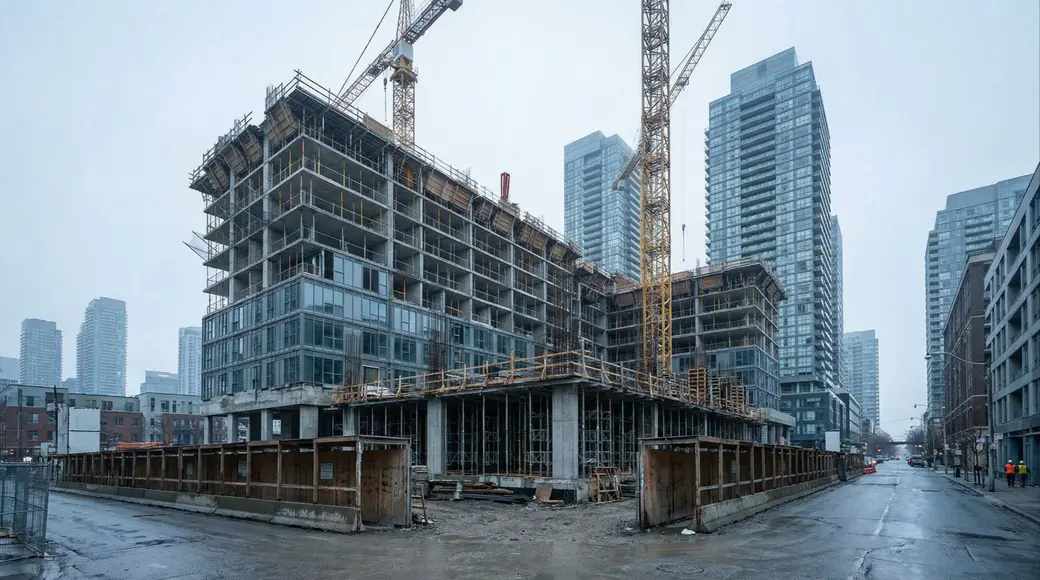
Metro Vancouver's $389M DCC Debate: What the Data Shows About Housing
The vote came after years of escalating friction between Metro Vancouver's regional government and the development industry over fees that have risen dramatically since 2015. At stake is not just a revenue figure, but whether enough housing gets built to meet the region's long-term needs — and who pays for the infrastructure required to support it.
What Are Development Cost Charges?
Development Cost Charges (DCCs) are fees collected by regional and municipal governments from developers at the time a building permit is issued. The revenue funds growth-related infrastructure — water systems, sewage treatment, drainage, and regional parkland — required to service new development.
Metro Vancouver's Board first directed staff in January 2026 to explore rolling back the 2026 DCC rate increase, reduce the 2027 rate, and extend the transition to a 1% assist factor. Staff returned with two options: a $246M revenue reduction (freeze 2026 and 2027 rates) or a $389M reduction (roll back the 2026 increase entirely). According to reporting by Howard Chai, the larger shortfall breaks down as $270.5M less in Water DCCs, $75.5M less in Liquid Waste DCCs, and $43M less in Parkland Acquisition DCCs.
In Metro Vancouver's Fraser Sewage Area, DCC rates have risen from $1,082 per unit in 2015 to $18,956 in 2026, with a further increase to $22,108 projected for 2027 — representing an increase of approximately 1,650% to date and nearly 2,000% projected by 2027.
What Developers Are Saying
The April 15 vote was preceded by a series of open letters from major regional developers urging the Board to approve the larger rollback. The most widely circulated was an April 13, 2026 letter from Brad Jones, Chief Development Officer of Wesgroup Properties, addressed directly to Chair Hurley and the MVRD Board.
Jones's central argument is that Metro Vancouver staff's $389M revenue loss projection assumes development activity continues at previously forecast levels — an assumption he argues is disconnected from current market conditions. He points to Q1 2026 pre-sales as the clearest evidence: just 87 units sold across all of Metro Vancouver, compared to a 10-year quarterly average of 3,900. He describes current home sales as tracking the second-slowest period in 24 years.
Rick Johal, president of Zenterra Developments, echoed the point in a separate letter shared with Daily Hive: "Lower development activity means lower DCC revenues regardless of the rate — a fact that should inform the Board's consideration of the true cost of inaction." Robert Bruno of Polygon Homes added in a January 2026 letter that pre-sales are "difficult, if not impossible in many markets" and that further cost pressures would result in additional job losses and fewer homes in an already undersupplied market.
Jones also frames the rollback not as a subsidy to developers, but as a partial correction of charges that have risen to unsustainable levels — noting they remain dramatically higher than they were a few years ago even after any proposed reduction.
What Independent Data Confirms
The developer letters are not the only voices raising alarms. Canada's national housing agency, CMHC, independently confirms the same trends in its Spring 2026 Housing Supply Report.
CMHC — Spring 2026 Housing Supply Report
Condominium starts fell sharply across the country as presales collapsed, investors pulled back, and costs stayed high. Vancouver recorded the highest unsold condominium inventory at completion of any major Canadian city. CMHC states: "With very few presales, developers will find it difficult to proceed with new condominium projects, resulting in limited apartment condominium starts over the next 2 years."
Monthly presale data makes the picture even more stark. In February 2026, only 64 new presale homes were launched across all of Greater Vancouver and the Fraser Valley — roughly 6% of a typical February's volume of over 1,100 units. Real estate analyst Steve Saretsky has described the presale environment as reflecting a market at a 25-year low, warning that housing starts over the next 12 to 18 months will look "really, really ugly" and that project cancellations are "becoming a daily event in Greater Vancouver."
A key contributing factor is reduced immigration. Federal cuts to immigration targets have pushed B.C. rents lower, deterring investors — the buyer pool that historically supported presale absorption. Without investors reaching presale thresholds, lenders will not advance construction financing and projects do not proceed.
The BC Real Estate Association has warned that if the current supply drought continues and demand eventually recovers, home prices in Metro Vancouver could jump by as much as 27% by 2032.
The City of Vancouver Disconnect
One underreported aspect of this debate is what analysts have called the "Metro Van offset problem." In December 2025, the City of Vancouver introduced a 20% temporary cut to its own Development Cost Levies — a meaningful step to lower construction costs within city limits. However, Metro Vancouver simultaneously proceeded with its own DCC increase on January 1, 2026, effectively cancelling out the city's reduction for many project types.
The Policy Coordination Problem
Analysis by the Missing Middle Initiative found that for a typical 100-unit apartment building in Vancouver, Metro Vancouver's DCC increase fully offset the City of Vancouver's DCL cut — leaving total per-unit charges unchanged. This same pattern occurred in 2023, when Metro Vancouver's increases captured the benefit of the federal GST cut on new housing. One level of government lowers costs; another level absorbs the savings.
The National Context: What Ontario Just Did
The Metro Vancouver vote is happening at the same moment as a landmark national policy shift that makes BC's position more conspicuous. On March 30, 2026, Prime Minister Mark Carney and Ontario Premier Doug Ford announced the Canada-Ontario Partnership to Build: a joint $8.8 billion investment over 10 years to fund housing-enabling infrastructure, explicitly designed to allow Ontario municipalities to reduce development charges by up to 50% for three years.
Vancouver Mayor Ken Sim immediately called on BC to pursue a similar deal, stating: "The agreement in Ontario offers a template for funding infrastructure and lowering the cost of building. We need a similar deal here in B.C." Industry sources at the Vancouver Real Estate Forum in late March suggested a BC agreement is currently under negotiation.
The Ontario model matters because it directly solves the core objection to DCC reductions: infrastructure still gets funded — through senior government investment rather than developer fees. Metro Vancouver's staff report, by contrast, proposes covering the revenue shortfall by raising ratepayer utility bills, increasing long-term borrowing, or deferring capital projects.
What the Data Doesn't Settle
While the developer case is well-supported by independent data, there are important questions the letters do not fully resolve.
Points Requiring Broader Context
- Infrastructure funding still has to come from somewhere. If DCCs fall — whether from a rollback or from declining construction — water, sewer, and parks infrastructure still needs to be built. Metro Vancouver staff have identified ratepayer increases, borrowing, and project deferrals as the options available absent a federal-provincial agreement.
- DCCs are one factor, not the only one. The construction slowdown also reflects elevated interest rates, reduced immigration, cautious lending conditions, investor retreat, and global tariff uncertainty. Reducing fees alone will not restart the pipeline immediately.
- Fee savings may not reach buyers. Economists note that whether developers pass cost reductions on to buyers — or protect margins — depends entirely on market conditions at the time of project launch.
- Process was not followed. Both the Wesgroup and Zenterra letters note the staff report advanced without notice to the industry working group that had been engaged for over a year — a concern separate from the economics.
What This Means for Housing Supply
The DCC debate is, at its core, a question of who pays for growth — and when. Development cost charges exist because new residents require new infrastructure, and it has been Metro Vancouver's longstanding position that growth should pay for growth. The question now is whether rates have risen to a level that undermines the very construction activity they depend on.
If projects don't proceed, governments collect no DCC revenue, build no infrastructure, and add no housing supply. The Ontario model suggests there is a path that doesn't require choosing between affordable development and funded infrastructure — but it requires senior government involvement that BC has not yet secured.
Frequently Asked Questions
Common questions about Development Cost Charges and what this vote means for buyers, renters, and the region.
What is a Development Cost Charge (DCC)?
A Development Cost Charge is a fee collected by a regional or municipal government from a developer when a building permit is issued. The money is used to fund infrastructure that new development requires — things like water mains, sewage systems, drainage, and parks. In Metro Vancouver, DCCs are charged at the regional level and collected on top of any municipal development fees.
Why have DCC rates increased so much?
Metro Vancouver has significant multibillion-dollar infrastructure projects underway, including the North Shore Wastewater Treatment Plant upgrade and drinking water system expansions. The regional district adopted a phased, multi-year schedule of DCC increases — approved in March 2024 — to fund these projects under the principle that "growth pays for growth." Since 2015, rates in the Fraser Sewage Area have risen from $1,082 per unit to $18,956 in 2026, with further increases planned for 2027.
Why do pre-sales matter so much to new housing construction?
In Canada, most new condominium towers are financed through pre-sales — contracts signed by buyers before construction begins. Lenders require developers to reach a minimum presale threshold (often 60–70% of units sold) before advancing construction financing. When presales collapse, as they have in 2026, developers cannot secure financing and projects do not proceed — regardless of how much they want to build.
If DCCs are reduced, will new homes become cheaper?
Not automatically. Whether developers pass savings on to buyers or protect their margins depends on market conditions. In a falling market — like the one Metro Vancouver is currently experiencing — buyers tend to benefit more from cost reductions, as developers need to price competitively. In a recovering or rising market, savings are more likely to be absorbed as developer profit. Economists, including those quoted in coverage of the Ontario DCC deal, have noted this uncertainty directly.
How does this affect me as a buyer or renter?
The DCC debate directly affects how much new housing gets built in Metro Vancouver over the next several years. If construction activity continues to decline, the supply of new homes will shrink — which puts upward pressure on prices and rents over the medium term. BCREA has projected that if the current supply shortfall is not addressed, home prices could rise by up to 27% by 2032. For renters, a thinner supply pipeline means less competition among landlords and continued pressure on affordability.
What happens to infrastructure if DCC revenue falls?
Metro Vancouver staff have identified three options: transfer the revenue shortfall to existing ratepayers through higher utility bills (staff recommend a 3% increase for 2027 and 5% annually through 2030, adding approximately $923 per household in 2027), increase long-term borrowing, or defer infrastructure projects. The Ontario model — where senior federal and provincial governments fund infrastructure directly — would avoid all three, but BC has not yet secured a similar agreement.
What is BC doing compared to Ontario?
On March 30, 2026, the federal and Ontario governments announced a joint $8.8 billion investment to fund housing-enabling infrastructure, allowing Ontario municipalities to cut development charges by up to 50% for three years. BC has not yet secured a comparable deal. Vancouver Mayor Ken Sim has formally called on the Province to pursue one. Industry sources indicate negotiations may be underway, but nothing has been confirmed as of the April 15, 2026 Metro Vancouver board meeting.
Will the DCC rollback actually restart construction?
Not immediately. Even if charges are reduced, developers still need to secure construction financing, rebuild buyer confidence, and work through the backlog of cancelled or stalled projects. From land acquisition to building completion, new housing projects typically take two to seven years. A fee reduction is a necessary condition for more construction — but not a sufficient one on its own. Interest rates, lending conditions, and buyer sentiment all need to align as well.
Sources
- Brad Jones, Wesgroup Properties — Open letter to Chair Hurley and the MVRD Board, April 13, 2026. Re: MVRD DCC Amendment Bylaw No. 1452, 2026. Shared via LinkedIn.
- Rick Johal, Zenterra Developments — Letter to the MVRD Board, shared with Daily Hive Urbanized, April 2026.
- Robert Bruno, Polygon Homes — Letter to MVRD Board of Directors, January 12, 2026.
- Howard Chai / Storeys — "Metro Vancouver Planning Up To $389M In DCC Reductions," April 12, 2026.
- Kenneth Chan / Daily Hive Urbanized — "Metro Vancouver Regional District ponders $389-million cut to developer fees," April 15, 2026.
- Daily Hive Urbanized — "Lower Mainland's presale home launches plunges to just 6% of a normal month," April 2026.
- CMHC — Spring 2026 Housing Supply Report, March 2026; Housing Market Outlook for Vancouver, January 2026.
- Missing Middle Initiative — "Metro Van Strikes Again: When One Government Cuts and Another Collects," December 19, 2025.
- UDI (Urban Development Institute) — Ongoing advocacy regarding Metro Vancouver DCC increases, 2024–2026.
- Prime Minister of Canada / PMO — Canada-Ontario Partnership to Build announcement, March 30, 2026.
- Vancouver Mayor Ken Sim — Statement calling on BC to pursue a federal-provincial housing infrastructure deal, April 2026.
- Metro Vancouver Regional District — MVRD DCC Amendment Bylaw No. 1452, 2026 agenda materials.
- Statistics Canada — Non-residential building permit data referenced in the Wesgroup letter.
- BC Real Estate Association (BCREA) — Forecast of potential 27% home price increase by 2032 if supply pipeline remains constrained.
This article is part of an ongoing series covering housing policy in Metro Vancouver. A video update breaking down what this vote means for buyers, renters, and the region's housing future is coming soon.
Debbie Evans | REALTOR®
eXp Realty | West Vancouver & North Shore Markets
Understanding what drives housing costs — beyond just the headlines — is the conversation worth having before you make your next move. If you're buying, selling, or trying to make sense of where the market is actually going, I'm here to help you see the full picture.
This content is for informational purposes only and does not constitute financial, legal, or investment advice. All information is sourced from publicly available documents, media reporting, and industry communications as of April 2026.
Categories
- All Blogs (97)
- aboriginal title ruling (2)
- bc housing market (23)
- bc real estate (55)
- Bill C-15 (1)
- build canada homes (8)
- Buyers Guide (4)
- canada strong fund (3)
- Canada-U.S. Trade (2)
- canadian real estate (15)
- Climate Change (2)
- Design & Build (4)
- Dundarave West Vancouver (1)
- Equity Growth (1)
- freehold (1)
- Home Buying Tips (1)
- housing policy (1)
- land claims (2)
- Land Claims / BC Real Estate (1)
- leasehold (1)
- local news (1)
- Lower Lonsdale (2)
- Market & Policy Analysis (1)
- Market Commentary (6)
- market insights (23)
- Multigenerational Living (2)
- North Vancouver Real Estate (19)
- open house (1)
- Open House Security (1)
- presale (1)
- real estate insights (7)
- Real Estate Market & Housing (2)
- Squamish Market Update (7)
- squamish real estate (8)
- squamish update (3)
- Vancouver Real Estate (17)
- West Vancouver Living (15)
- West Vancouver Real Estate (26)
- Whistler Market Update (4)
Recent Posts







Have a Question? Let’s Talk. I’m Here to Help.

North Shore & Vancouver Realtor License ID: 175378
+1(778) 875-4934 | debbie.evans@exprealty.com