
Pierwell Has a New Owner — What Could This Mean for Dundarave?
Pierwell Has a New Owner — What Could This Mean for Dundarave?
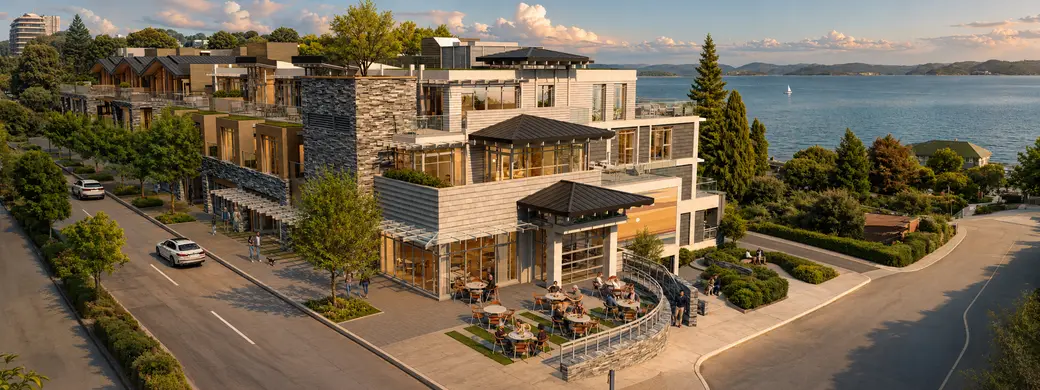
For those of us who live in Dundarave, the Pierwell site has been more than a stalled development — it's left a very noticeable gap in the middle of our village. I walk past it almost every day, and I've watched it go from active businesses, to demolition, to construction, to a long, quiet stop.
Now there's finally movement. A B.C. Supreme Court judge has approved the court-supervised sale of the Pierwell property at 2468 Marine Drive to Basel Capital, a Seattle-based development and investment group with international connections, for approximately $37.5 million. The transaction is expected to close in September 2026.
Current reporting suggests the new owner may be considering moving ahead with the existing approved project — but that hasn't been formally confirmed. So while I don't yet know exactly what Basel Capital intends to build, I know what this sale means for the neighbourhood, and as a designer and a REALTOR® who toured the original project, I have some thoughts on what could happen next.
An Important Piece of Dundarave
The District of West Vancouver approved a development permit for Pierwell in July 2022 — a three-storey mixed-use building on Marine Drive. The project later went into receivership, and the recent court-supervised sale has created a real sense that something may finally move forward again.
For me, though, this has never been just a development story. I live in Dundarave and walk past this site almost every day. I remember shopping at the Shoppers Drug Mart that used to be on this stretch, and I have watched businesses close, buildings come down, construction begin, and then the whole project sit quiet.
A Village Story, Not Just a Development Story
A few days ago, my son and I were walking through Dundarave and ended up talking about how much this particular stretch of Marine Drive has changed. We had stopped at IGA, directly across from the Pierwell site, and when he looked over at the project he remembered when Eurohouse Construction had its offices there before the redevelopment moved forward and the company had to relocate.
Later, sitting across the street over lunch at the Red Lion — one of Dundarave's best-known neighbourhood pubs — we kept talking about the site and what it could eventually mean for the village.
Immediately beside Pierwell is Martine Boré Antiques Ltd. at 2442 Marine Drive. Her shop has an extraordinary collection of fine furniture, art, sculpture, antiques and decorative pieces. As an interior designer, I can easily imagine future Pierwell residents walking next door looking for exactly the kind of distinctive pieces that give a new luxury residence character and individuality.
Her pieces are also particularly well suited to a project like Pierwell. Some of the most refined interiors come from mixing contemporary architecture with antique, vintage and collectible pieces rather than furnishing everything from one period or one showroom.
A successful interior is usually about the mix. You might have a beautifully tailored modern sofa beside an antique side table, contemporary lighting paired with an older painting, or a sculptural collectible sitting within a very clean architectural setting. It is that contrast that gives a room depth, character and personality.
I have always believed that a home should reflect the people who live in it. You can often walk into a space and immediately sense whether it has been thoughtfully collected and layered over time, or whether everything was simply selected at once to fill the room. A beautifully finished new residence can still feel flat or overly staged if it has no sense of individuality.
Italy does this particularly well. You often see historic architecture paired with contemporary furniture, modern art and lighting, creating interiors that feel sophisticated and effortless rather than themed. In a new development like Pierwell, that idea can work beautifully in reverse: start with clean, contemporary architecture and layer in antique furniture, original art, sculpture and collected objects to give the home warmth, history and personality.
That is exactly why a shop like Martine Boré Antiques could be such a natural fit for future Pierwell residents. Her pieces can provide a layer of character and individuality that can be difficult to achieve through new construction alone. Good design is not about making everything match — it is about knowing how to combine periods, materials and objects so the finished interior feels intentional, refined and personal.
That is what a completed mixed-use development can potentially bring back into a neighbourhood: residents, customers, activity and connection between the people who live there and the businesses already established around them.
Hopefully, as this stretch of Dundarave comes back to life, the added street traffic, new residents and everyday hustle and bustle will benefit all of the local businesses around it. After such a long period of inactivity, this feels like a very welcome change for the village.
I Toured the Original Pierwell — and the Design Was Beautiful
I toured the original Pierwell presentation, and I was genuinely impressed. The project was planned as a limited collection of 36 residences, with architecture by Arcadis IBI Group and interiors by Cristina Oberti Interior Design. The original specification package featured Stosa Italian cabinetry.
As a designer, that got my attention. I love Italian product, and the European influence throughout Pierwell was handled beautifully — the interiors felt sophisticated and genuinely appropriate for this market. Honestly, I was a little surprised by how high-end some of the specifications were. That's not a criticism; they were beautiful. But it does raise an interesting question now that a new owner is taking over: how much of that original design stays, and where might a new team choose to refine it?
Why Keeping the Existing Architecture Could Make Sense
Pierwell already has an approved development permit. That doesn't mean Basel Capital can't make changes — and exactly what additional municipal review would be triggered depends entirely on what they end up proposing. But from a development standpoint, there's often a real incentive to work within an already-approved architectural framework rather than start over.
Major changes to building form, massing, density, height, use, or setbacks can trigger amendments and additional municipal review — which means time and cost. If a purchaser can retain much of what's already approved, that's potentially a faster path back to construction than a full redesign. Where I think the real opportunity sits isn't in the architecture at all. It's inside the building.
This is where my interior design and construction background makes me particularly curious about what happens next. A new owner can take an existing finish package — cabinetry, millwork, stone, appliances, plumbing fixtures, lighting, flooring, hardware, bathroom specifications — and examine every line of it. On a project with dozens of units, small changes multiplied across the whole building can add up to a substantial difference in construction cost.
Interestingly, Basel Capital itself identifies value engineering as part of its development approach, along with procurement and project management — which makes this an especially relevant part of the project to watch.
Good value engineering isn't about making everything cheaper. It's about asking sharper questions:
- Where are we paying for brand, versus paying for quality?
- Which specifications will the buyer actually see, touch, and notice — and which won't they?
- Where can the same aesthetic and performance be achieved through a different manufacturer or method?
- Where should the budget never move — and where could savings elsewhere fund an upgrade instead?
Done well, this preserves the design intent, protects quality, removes unnecessary cost, and can even elevate certain elements. Done poorly, it just strips a project down. The difference between the two is entirely in the details.
The Look Matters More Than the Label
The original Italian cabinetry is one of the things I remember most about Pierwell, and it contributed a lot to that European design language. But retaining the aesthetic doesn't require retaining the exact original manufacturer. There are exceptional cabinetry and millwork makers throughout Italy and Europe, as well as in Canada, Asia, and elsewhere — I work with international suppliers regularly, and this is a question I ask on my own projects all the time.
The question isn't "what costs less at the factory." It's "how do we get the design and quality level we want for the best overall project outcome." That's a very different calculation — and it's one that's gotten more complicated recently.
The Government of Canada's Department of Finance imposed a provisional 25% safeguard surtax on certain imported wood cabinets, vanities, and related subassemblies, effective July 31, 2026, while the Canadian International Trade Tribunal conducts its inquiry — the measure can remain in place for up to 200 days, and some countries and products are exempted under the order. By the time a project like Pierwell reaches full procurement, this specific measure may look different — that's exactly the point. For a development team, comparing factory prices alone doesn't tell the whole story. The number that actually matters is the total landed and installed cost: freight, duties, applicable tariffs, exchange rates, customs and brokerage, warehousing, lead time, installation, warranty and service, and the cost of schedule risk if a shipment is delayed. Sometimes the higher-priced product at the factory door turns out to be the better value by the time it's installed. Sometimes it's the reverse — but you only know if you run the whole calculation.
Could Pierwell Be Refined — and Possibly Even Improved?
I think this is genuinely the interesting part of what comes next. The original Pierwell was already well conceived — I'm not starting from the assumption that it needs reinventing. But there's a real opportunity here for a new team to keep what worked and carefully reconsider the rest: the architecture largely as approved, the interior package reviewed line by line, some specifications simplified while others are elevated, and sourcing decisions that account for today's trade environment rather than the one that existed when the original package was specified.
That's what thoughtful value engineering does. It isn't about stripping quality out of a luxury project — it's about understanding exactly where every dollar is going, and making sure it's landing somewhere the buyer will actually experience.
Luxury Buyers Will Still Expect Luxury
As a REALTOR®, I see the other side of this too. West Vancouver buyers are sophisticated. At this price point, people notice cabinetry quality. They feel the difference in hardware. They see stone, lighting, appliance packages, and how a bathroom is actually detailed. Value engineering can't become specification-cutting — the best development teams know exactly where buyers perceive value, protect those details, find real efficiencies where nobody will ever notice the difference, and make the overall economics work. That's where good development and good design meet.
Dundarave Needs This Site Moving Again
There will be plenty of time to dig into the actual design once Basel Capital tells us what it plans to build. For now, the sale itself is the good news. I loved a great deal of the original Pierwell concept, and I'd be genuinely happy to see that architectural and design quality carried forward. I'm just as interested in whether a new team can take that vision, fine-tune it for today's construction and trade environment, and — done thoughtfully — leave the project even stronger than where it started.
Mostly, I want to see this block come back to life. I walk past it every day. I remember what used to be here. I've watched this site sit still for a long time now, and like many people who live and work in Dundarave, I'm ready to see the lights come back on along this stretch of Marine Drive.
Quick Questions
Is Basel Capital definitely building the original Pierwell design?
Not confirmed. Sources have indicated that's the current plan, but Basel Capital hasn't formally announced its intentions, and no one should assume the original design is locked in until they do.
Does Basel Capital need new municipal approval to build?
The project received development permit approval in 2022. Whether Basel can proceed under the existing approvals, or whether amendments or additional municipal review would be required, will depend on the plans it ultimately submits.
Will Basel source cabinetry and finishes from China because of its Hong Kong connections?
There's no evidence of that. An internationally connected developer may simply have access to a broader procurement network — but until specifications are announced, sourcing is speculation.
Is the 25% cabinetry tariff permanent?
No. It's a provisional safeguard surtax that took effect July 31, 2026 and can remain in place for up to 200 days while the Canadian International Trade Tribunal completes its inquiry. It's used here as an example of why sourcing decisions need constant reassessment, not as a fixed cost assumption for this project.
- North Shore News — "West Vancouver condo project in receivership, causing 'heartbreak' in Dundarave"
- District of West Vancouver — Pierwell development permit records (approved July 2022)
- Pierwell — original project interiors, Stosa Cucine cabinetry, design team and specifications
- Government of Canada, Department of Finance — Certain Wood Cabinet and Vanity Goods provisional safeguard surtax, effective July 31, 2026 (inquiry conducted by the Canadian International Trade Tribunal)
- Basel Capital — company development approach, including value engineering, procurement and project management
westvanliving.ca
Categories
- All Blogs (103)
- aboriginal title ruling (2)
- B.C. Policy (1)
- bc housing market (24)
- bc real estate (56)
- Bill C-15 (1)
- build canada homes (10)
- Buyers Guide (4)
- canada strong fund (4)
- Canada-U.S. Trade (2)
- canadian real estate (16)
- Canadian Real Estate & Housing (1)
- Climate Change (2)
- Cost of Living (2)
- Design & Build (4)
- Dundarave West Vancouver (1)
- Equity Growth (1)
- Federal Policy (1)
- freehold (1)
- Home Buying Tips (1)
- Household Debt (1)
- housing policy (1)
- land claims (2)
- Land Claims / BC Real Estate (1)
- leasehold (1)
- local news (1)
- Lower Lonsdale (2)
- Market & Policy Analysis (1)
- Market Commentary (6)
- market insights (23)
- Market Intelligence (1)
- Mortgage Delinquencies (1)
- Mortgage Renewals (1)
- Multigenerational Living (2)
- North Vancouver Real Estate (19)
- open house (1)
- Open House Security (1)
- presale (1)
- real estate insights (7)
- Real Estate Market & Housing (2)
- renovation (1)
- Squamish Market Update (7)
- squamish real estate (8)
- squamish update (3)
- Vancouver Real Estate (17)
- West Vancouver Living (15)
- West Vancouver Real Estate (26)
- Whistler Market Update (4)
Recent Posts









Have a Question? Let’s Talk. I’m Here to Help.

North Shore & Vancouver Realtor License ID: 175378
+1(778) 875-4934 | debbie.evans@exprealty.com