
How the North Shore Got 28+ Currency Exchanges — And What the Apadana Collapse Reveals
How the North Shore Got 28+ Currency Exchanges — And What the Apadana Collapse Reveals
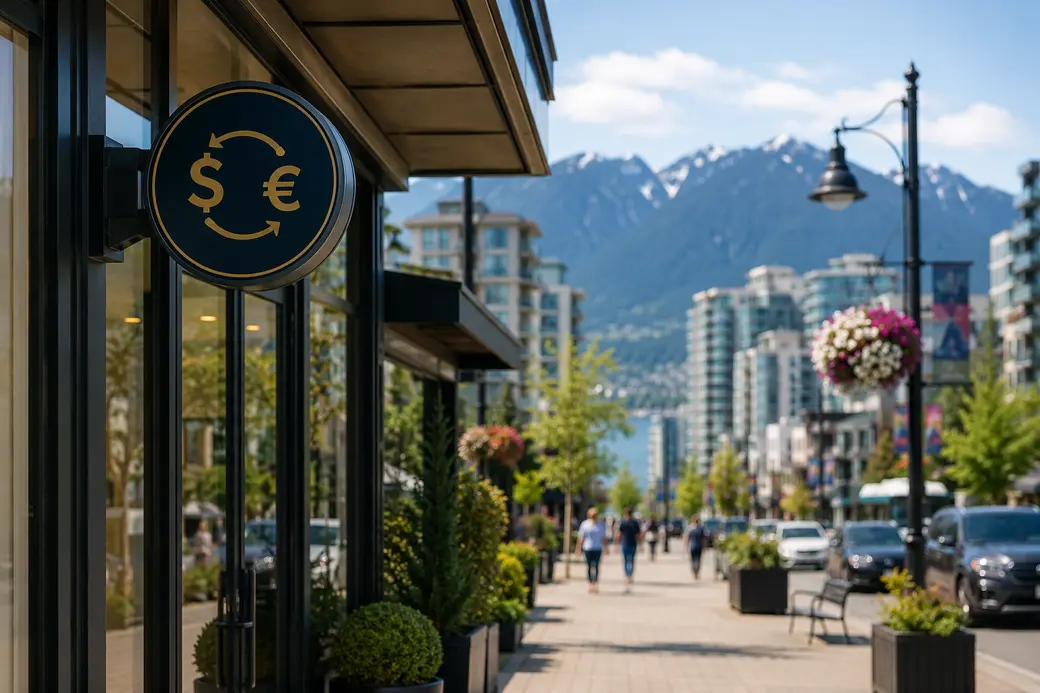
Hundreds of Apadana Currency Exchange customers in North Vancouver are now suing to recover up to $5 million in frozen transfers. It's a shock story on its own — but it's also the outcome regulators and two North Shore councils have been publicly worried about for years, with counts as high as 28 currency exchanges in one municipality alone. As a REALTOR®, this hits close to home for a specific reason: both real estate and currency exchanges are regulated, but for very different purposes. Real estate has had its own scandals too — but the system built around it includes designated trust accounts, mandatory audits, regulator intervention powers, and (within real limits) a compensation fund. FINTRAC, which governs currency exchanges, was built to catch money laundering, not to protect your money if a business fails. Here's the comparison, sourced.
What happened at Apadana
Apadana Currency Exchange, a money services business on Marine Drive in North Vancouver, froze all deposits, withdrawals and transactions this month. Owner Hamidreza Karimi has acknowledged that between 200 and 300 customers are collectively owed between $4 million and $5 million, and says he is working with a customer committee to declare his assets and find a way to repay them. Affected customers, many of whom had sent home-sale proceeds, life savings or funds earmarked for real estate purchases, have begun filing civil suits in provincial court to try to recover what they're owed.
So how many of these businesses are there?
The North Shore has been publicly arguing about exactly this question since 2021 — well before Apadana made headlines.
| Municipality | Verified count | Source / context |
|---|---|---|
| City of North Vancouver | 28 money services businesses | Cited by council when it passed a November 2024 bylaw barring new currency exchanges from opening at street level; the 28 existing businesses were grandfathered in |
| District of West Vancouver | ~13 currency exchanges (as of 2021) | Cited by Coun. Nora Gambioli when council first moved to cap financial-services storefronts in Ambleside and Dundarave; the number that prompted the district's 2022 bylaw |
Both figures are official, on-the-record numbers tied to actual council votes, not informal counts. West Vancouver's bylaw was expanded in 2024 to also restrict crypto exchanges, gold and jewelry buyers and NFT dealers to upper floors — but no council report puts a verified combined total on those categories, so we're not going to estimate one here.
FINTRAC compliance isn't the same as protecting your money
As a REALTOR®, I go through FINTRAC training regularly, and I want to be precise about what that training actually covers — because currency exchanges are FINTRAC-regulated too, and it's easy to assume that means the same protections apply. They don't.
Real estate professionals and money services businesses (MSBs) are both "reporting entities" under the same federal law, the Proceeds of Crime (Money Laundering) and Terrorist Financing Act. Both of us have to verify client identity, keep records, and report large or suspicious transactions. MSBs additionally have to register directly with FINTRAC before they can operate at all.
But FINTRAC's mandate is anti-money-laundering and anti-terrorist-financing — catching the suspicious movement of money. FINTRAC does not impose a trust-account segregation system equivalent to the one governing BC real estate brokerages, and it was never built to check whether a business can actually pay its customers back. FINTRAC registration is not deposit insurance, not a solvency guarantee, and not a guarantee of repayment.
How BC real estate protects your money — and where the limits are
This is the part I think people genuinely don't know, and it's worth laying out plainly, because it's the direct answer to "how are my funds held, and what happens if something goes wrong?"
| BC real estate brokerages | Money services businesses (currency exchanges) | |
|---|---|---|
| Where client funds sit | Client trust funds must be held in designated brokerage trust accounts under BC real estate legislation | No equivalent FINTRAC trust-account segregation requirement. FINTRAC regulation is focused primarily on anti-money-laundering and terrorist-financing compliance |
| Reconciliation | Monthly trust reconciliations required by law | No equivalent requirement |
| Independent audit | Annual accountant's report verifying trust liabilities are fully covered, plus BCFSA's own risk-based on-site audit program | FINTRAC examinations check AML/reporting compliance, not financial solvency |
| Regulator's power to intervene | BCFSA can freeze a brokerage's trust accounts and seek a court-appointed receiver | No equivalent proactive power tied to protecting customer funds |
| Compensation mechanism | BC's Special Compensation Fund, subject to eligibility and set limits | No compensation fund or deposit-insurance equivalent |
That protection has real limits, and it's worth being upfront about them. BC's Special Compensation Fund can pay a maximum of $200,000 to a single claimant, and no more than $1,000,000 in total against a single brokerage, regardless of how many people are affected. Compensable losses must meet specific eligibility requirements and generally have to be established through a hearing on the evidence. Real estate has had real scandals too. The important difference is that regulators have specific powers to freeze trust accounts, investigate potential misconduct and, where eligibility requirements are met, consumers may have access to BC's Special Compensation Fund. That creates layers of protection that do not exist in the same form for customers of a money services business.
BC's system was tested directly in November 2025, when BCFSA froze the trust accounts of Jovi Realty and Lighthouse Realty amid an investigation connected to broker Balpreet Singh Bal, including allegations that roughly $2.75 million had been moved out of a trust account into Jovi's operating account and left there for more than a month. BCFSA suspended both brokerages' licenses later that month, and on April 2, 2026, the BC Supreme Court appointed an independent receiver, D. Manning & Associates Inc., to take control of the frozen accounts, reconcile them, and oversee distribution to affected parties. Consumers impacted by the matter may be eligible to seek compensation through the Special Compensation Fund, subject to its limits. None of the misconduct alleged in this matter has been established by a final regulatory or court finding.
In Ontario, the collapse of iPro Realty demonstrated another version of this protection system. By January 2026, RECO reported that approximately $5 million in consumer deposit claims had already been paid through the province's mandatory insurance program and said no consumers had been negatively impacted. A separate process for unpaid REALTOR® commissions was still underway at that point; RECO later committed to paying those claims in full as well, drawing on its insurance program's stability fund.
Both industries are regulated. They're just regulated for different risks. Real estate's system — trust accounts, audits, intervention powers, a compensation fund with real but defined limits — exists specifically to protect consumer funds. FINTRAC's system exists to catch money laundering and terrorist financing. Neither Apadana's customers, nor anyone using a currency exchange, has access to anything resembling the first kind of system.
When you hand a business hundreds of thousands of dollars, do you know how that money is legally required to be held? Is it segregated from the business's own money? Is the account reconciled and subject to regulatory oversight? And is there any compensation mechanism if funds disappear? Those are very different questions from simply asking whether the business is "regulated." For buyers and sellers moving home-sale proceeds, deposits or purchase funds, understanding that distinction can matter enormously.
What this means if you're moving money for a real estate deal
- Funds held in a BC real estate brokerage trust account are subject to the real estate trust-account requirements described above. Lawyers and notaries also operate regulated trust-account systems, although their rules, oversight and compensation arrangements are governed separately.
- Funds moved through a money services business are not subject to an equivalent trust-account segregation requirement. FINTRAC registration relates to anti-money-laundering compliance, not fund protection.
- Before moving significant sums through any channel, ask directly how the funds are held, whether the account is audited, and what compensation mechanism, if any, applies if something goes wrong.
Frequently Asked Questions
- Is it illegal to run a currency exchange on the North Shore?
- No. Money services businesses are legal and federally registered with FINTRAC. The municipal bylaws in West Vancouver and North Vancouver restrict where new ones can locate at street level; they don't ban the businesses themselves.
- Does FINTRAC registration protect customers if a currency exchange becomes insolvent?
- No. FINTRAC registration relates to anti-money-laundering and terrorist-financing compliance. It is not deposit insurance, a solvency guarantee, or a guarantee of repayment, and there is no compensation fund for money services business customers equivalent to what exists in real estate.
- How is my money protected when I work with a real estate brokerage in BC?
- Client funds must be held in a segregated, designated trust account, reconciled monthly, and verified annually by an independent accountant's report. BCFSA also runs its own risk-based audit program and can freeze a brokerage's trust accounts and seek a court-appointed receiver if misconduct is suspected. Where eligibility requirements are met, BC's Special Compensation Fund can provide compensation, capped at $200,000 per claimant and $1,000,000 in total per brokerage.
- How many currency exchanges are there across the whole North Shore?
- The only verified, sourced figures are 28 in the City of North Vancouver (as of the November 2024 bylaw) and roughly 13 in West Vancouver's Ambleside/Dundarave area (as of the 2021 count that prompted its bylaw). We don't have a reliable combined North Shore total, or a separate verified count for gold/jewelry/crypto businesses.
Vancouver Sun, "Clients of North Vancouver currency exchange file court suits in effort to recover up to $5 million," Aug. 27, 2026
North Shore News, "City of North Vancouver bans new currency exchanges at street level," Nov. 7, 2024
North Shore News, "City of North Vancouver moves to limit currency exchanges," Oct. 27, 2024
North Shore News, "West Vancouver to limit nail salons and money exchanges along Marine Drive," Dec. 20, 2021
North Shore News, "Street-level crypto-currency traders, gold sellers to be limited in West Van," Mar. 16, 2024
North Shore News, "Why are there so many currency exchanges in North Vancouver?" May 31, 2024
BC Financial Services Authority, "Special Compensation Fund"
BC Financial Services Authority, "BCFSA Issues Urgent Orders, Freezes Trust Accounts Over Alleged Misconduct by Balpreet Singh Bal and Related Brokerages," Nov. 6, 2025
BC Financial Services Authority, "Receiver Appointed for Jovi Realty and Lighthouse Realty Trust Accounts," Apr. 8, 2026
Real Estate Council of Ontario, "Update on iPro Realty insurance claims and ongoing actions," Jan. 6, 2026, and "RECO announces full payment of eligible iPro commission protection claims," Jan. 21, 2026
Categories
- All Blogs (103)
- aboriginal title ruling (2)
- B.C. Policy (1)
- bc housing market (24)
- bc real estate (56)
- Bill C-15 (1)
- build canada homes (10)
- Buyers Guide (4)
- canada strong fund (4)
- Canada-U.S. Trade (2)
- canadian real estate (16)
- Canadian Real Estate & Housing (1)
- Climate Change (2)
- Cost of Living (2)
- Design & Build (4)
- Dundarave West Vancouver (1)
- Equity Growth (1)
- Federal Policy (1)
- freehold (1)
- Home Buying Tips (1)
- Household Debt (1)
- housing policy (1)
- land claims (2)
- Land Claims / BC Real Estate (1)
- leasehold (1)
- local news (1)
- Lower Lonsdale (2)
- Market & Policy Analysis (1)
- Market Commentary (6)
- market insights (23)
- Market Intelligence (1)
- Mortgage Delinquencies (1)
- Mortgage Renewals (1)
- Multigenerational Living (2)
- North Vancouver Real Estate (19)
- open house (1)
- Open House Security (1)
- presale (1)
- real estate insights (7)
- Real Estate Market & Housing (2)
- renovation (1)
- Squamish Market Update (7)
- squamish real estate (8)
- squamish update (3)
- Vancouver Real Estate (17)
- West Vancouver Living (15)
- West Vancouver Real Estate (26)
- Whistler Market Update (4)
Recent Posts









Have a Question? Let’s Talk. I’m Here to Help.

North Shore & Vancouver Realtor License ID: 175378
+1(778) 875-4934 | debbie.evans@exprealty.com