
What Does China Actually Have to Do With CUSMA? Tariffs, Transshipment and the Rules Canadians Aren't Hearing About
What Does China Actually Have to Do With CUSMA? Tariffs, Transshipment and the Rules Canadians Aren't Hearing About
Why China Is Part of This At All
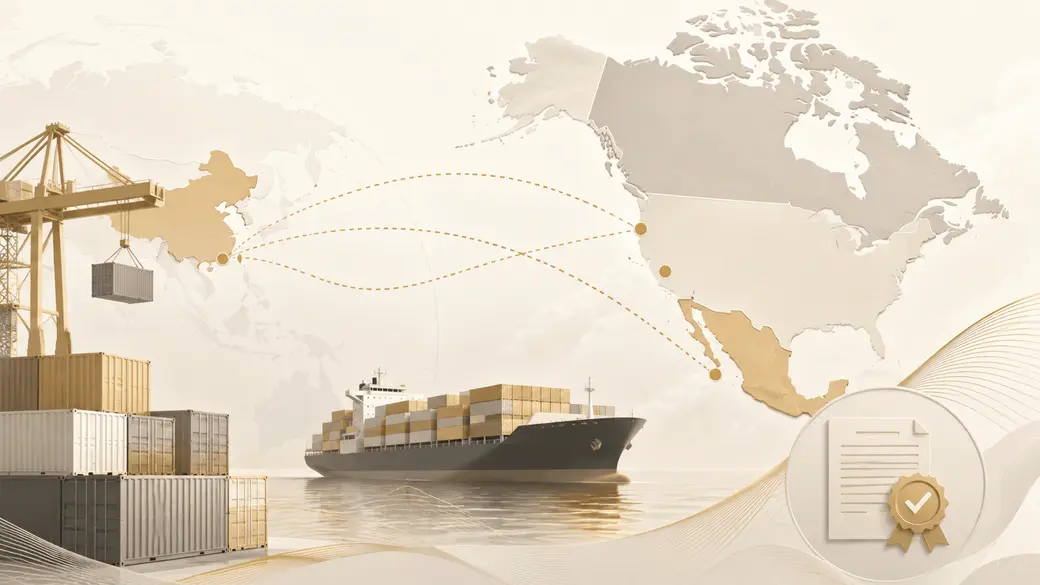
CUSMA gives Canadian, American, and Mexican goods preferential access to each other's markets — reduced or eliminated tariffs that goods from outside the agreement don't get. That preference only makes sense if there's a reliable way to confirm a product actually qualifies as North American-made. Otherwise, a country outside the agreement could simply route goods through a member country, relabel or lightly process them, and claim the preferential tariff treatment meant for genuine North American production.
China is the country most often named in this conversation because it's the world's largest manufacturing exporter and currently faces steep, separate U.S. tariffs of its own. That combination — large export volume plus a strong incentive to find a lower-tariff path into the U.S. market — is exactly the scenario rules of origin are designed to prevent. Whether that's actually happening at meaningful scale through Canada, and how much of it is happening, are separate questions from whether the concern itself is legitimate. Both deserve honest treatment.
Rules of Origin, Explained Simply
Imagine a Canadian company builds an appliance using a mix of parts: a circuit board from China, sheet metal from the U.S., and final assembly, wiring, and quality testing done at a plant in Ontario. Is that a Canadian product? Under CUSMA, the answer depends on specific, detailed rules — generally some combination of how much of the product's value was added in North America (regional value content) and whether the manufacturing process caused enough of a transformation in the product's tariff classification (a "tariff shift"). If the finished appliance meets those thresholds, it qualifies as CUSMA-originating, regardless of the Chinese circuit board inside it. If it doesn't meet them, it doesn't qualify — even if it was physically assembled in Canada.
That's the key distinction the current debate often loses: using imported components, including from China, is not the problem. Virtually every North American manufacturer uses some imported inputs. The rules exist to determine whether the finished product underwent enough genuine North American transformation to earn preferential treatment — not to police where every screw or component originated.
Transshipment vs. Legitimate Manufacturing: Three Different Situations
A lot of the confusion in this debate comes from blending together three genuinely different scenarios:
- Legitimate manufacturing using foreign inputs: A Canadian company imports components and adds enough North American value or processing to meet CUSMA's origin rules. This is ordinary, legal, and common — the appliance example above.
- Legitimate transshipment: Goods pass through Canada en route to another destination without any attempt to disguise their true origin or claim tariff benefits they don't qualify for. Nothing improper here either.
- Illegal transshipment or tariff circumvention: Goods are routed through Canada with minimal or superficial processing specifically to disguise their true origin, misdeclare their country of origin, or falsely claim CUSMA preferential treatment they don't actually qualify for. This is the scenario U.S. trade officials are concerned about — and it's the only one of the three that's actually a problem.
Treating all three as the same thing is what makes this issue sound more alarming than the underlying mechanics justify. A Canadian business legally using Chinese components is not evidence of anything improper.
This Isn't a New Concern — Canada and the U.S. Addressed It in Writing in 2019
If the idea of verifying true product origin and guarding against transshipment sounds like a brand-new 2026 invention, it isn't. Canada and the U.S. formally addressed exactly this issue seven years ago, resolving an earlier steel and aluminum tariff dispute. The Government of Canada's own published text of that joint statement is direct:
The two countries also agreed to a monitoring system distinguishing steel "melted and poured" in North America from steel processed elsewhere. Canada later formalized this through its own customs reporting: beginning November 5, 2024, importers of applicable steel products were required to report country-of-melt-and-pour information as a term and condition of using General Import Permits No. 80 and No. 81 — not a universal requirement on every steel import in every circumstance, but a specific condition tied to those permits.
What Canada Has Already Done on Its Own — Documented, Not Alleged
This is worth stating clearly, because it's sometimes framed as though origin-verification pressure only comes from the U.S. side. It doesn't. Effective July 31, 2025, Canada imposed a 25% surtax on certain imported steel goods containing steel melted and poured in China, and on certain aluminum goods containing aluminum smelted and cast in China — a specified list of goods, not a blanket measure covering every Chinese steel or aluminum product. The stated purpose, per the Government of Canada:
That surtax applies to the specified goods on the order's list — importers must produce documentation (mill certificates, chemical analysis reports, and similar) proving the steel or aluminum wasn't melted, poured, smelted, or cast in China, or pay the surtax. Separately, the CBSA opened a formal anti-dumping and anti-subsidy investigation in April 2026 into steel storage racks from China, following a complaint from five Canadian manufacturers alleging real harm — lost sales, price erosion, and reduced employment. That investigation remains active: on July 16, 2026, the CBSA extended the preliminary investigation period from 90 to 135 days, citing the variety of goods involved and difficulty obtaining satisfactory evidence. A preliminary determination — or termination of the investigation, if the evidence doesn't support it — is now expected by September 2, 2026. As of this writing, no determination has been made, and the manufacturers' allegations remain just that: allegations the CBSA and the Canadian International Trade Tribunal are still investigating, not a proven finding.
The point isn't that these specific cases prove a broader transshipment problem through Canada — they don't, on their own. The point is that Canada has its own documented history of treating Chinese steel and aluminum trade practices as a genuine concern, independent of anything the U.S. has asked for. This isn't a concern invented solely to satisfy American negotiators.
What a New U.S. Government Report Says About Canada
On August 13, 2026, the White House Office of Trade and Manufacturing Policy released a report titled "The Great Transshipment Scam," and it has since been widely covered — Fox News, The Hill, Fortune, the Epoch Times, and others have all reported on it. It's directly relevant here: the report explicitly places Canada in its highest-volume risk category — a "Tier 1 Diversified Scale Leader," alongside the European Union, Japan, Mexico, South Korea, and others — and separately lists Canada among a small group of "Developed Logistics Platforms." White House trade adviser Peter Navarro, who led the report's release, told reporters: "For years, the great transshipment scam has let communist China launder its exports."
The report has drawn pushback from several of the governments it names. China's Commerce Ministry called it a narrative that "disregards facts and distorts the truth." The European Union and Singapore have also pushed back on their inclusion. As of this writing, Prime Minister Carney has not issued a specific response to the report's claims about Canada — though his government has separately raised its own concerns about Chinese trade diversion, including measures announced in July 2025 aimed at Canada's steel sector, and Carney has repeatedly pointed to roughly 85% of Canada-U.S. trade remaining tariff-free under CUSMA as evidence of a generally functioning relationship.
It's worth being precise about what the report's Canada placement is actually based on, because the report is explicit about its own limits. Canada's inclusion rests on an aggregate statistical pattern — as China's direct share of U.S. imports fell after the 2018 Section 301 tariffs, the combined import share from roughly 40 identified "risk" countries, Canada among them, rose. The report states plainly: "This relationship does not establish that all displaced Chinese trade was illegally transshipped... The open question this report examines is how much of this apparent reallocation reflects illegal transshipment rather than legitimate shifts in production and trade." No specific Canadian company, shipment, customs case, or enforcement action is cited anywhere in the report.
That distinction matters for the same reason the rest of this article has emphasized it: a country appearing in a trade-flow risk tier is not the same thing as a proven finding against that country. It's a government office's own analytical framework and a documented policy position — not a court finding, an audited investigation outcome, or evidence of a specific violation. Independent commentary on the report has made a similar point: building a genuine factory in a third country that performs real manufacturing is legal, even if partly motivated by avoiding a tariff — that's ordinary "substantial transformation" under customs law — while relabeling a finished product without real transformation is not, and the report's own top-line statistics can't distinguish between the two. Readers can draw their own conclusions about the report's broader argument, but the distinction between "the U.S. government has published this position" and "this has been proven" is one worth holding onto here just as much as anywhere else in this dispute.
The full report is available directly from the White House: "The Great Transshipment Scam," Office of Trade and Manufacturing Policy, August 13, 2026.
What Article 32.10 Actually Says — And What It Doesn't
This is the specific CUSMA provision that's become a flashpoint. Here's the actual treaty language, from the Government of Canada's own published text:
| What Article 32.10 covers | |
|---|---|
| Applies to | A Party signing a new free-trade agreement with a country the others consider a "non-market economy" |
| Consequence | The other two parties gain the option to end CUSMA on six months' notice and negotiate a bilateral replacement between themselves |
| Does NOT restrict | Ordinary commercial trade — importing, exporting, or doing business with China or any other country |
| Applies to | All three countries identically — Canada, the U.S., and Mexico each have the same right if either of the other two signs such a deal |
| Automatic termination? | No — it creates an option for the other parties to exercise, not an automatic end to CUSMA |
It's also not a new idea in North American trade law — NAFTA had a general withdrawal clause of its own, and Article 32.10 has existed, unchanged, since CUSMA was signed in 2018.
Documented Fact vs. Allegation vs. Negotiating Position
Given how much of this debate involves claims that are hard to verify, it's worth being explicit about which category different pieces of this actually fall into:
- Documented fact: Article 32.10's exact text; the 2019 Canada-U.S. joint statement on transshipment; Canada's own 2025 surtax on Chinese steel and aluminum; the April 2026 CBSA anti-dumping investigation into Chinese steel racks; the existence and content of the White House's August 2026 transshipment report itself.
- Government allegation, not yet independently proven: Complaints from Canadian steel-rack manufacturers that Chinese imports are causing them specific injury — this is what the CBSA and CITT investigations exist to determine, and a preliminary finding is not the same as a final, proven conclusion. Similarly, the White House report's placement of Canada in a "Tier 1" transshipment-risk category is a government analytical position based on aggregate trade-flow statistics, not a documented finding against any specific Canadian company or shipment — a distinction the report itself acknowledges.
- Negotiating position, not documented policy: Any claim about the specific scope of what the U.S. wanted Canada to change regarding trade with third countries during the August 2026 talks — Prime Minister Carney has not detailed how broad that provision would have been, and no negotiating text has been made public.
What this article does not claim: that Canada is systematically being used to relabel Chinese goods as Canadian-made, or that most Chinese components entering Canadian manufacturing represent any kind of circumvention. There's no evidence supporting either of those broader claims in the documentation reviewed here — and the difference between "the U.S. and Canada both consider origin verification a legitimate concern" and "there's proven widespread transshipment happening" is exactly the kind of distinction worth holding onto.
Why This Reaches Beyond Trade Lawyers
Stricter origin verification and enforcement isn't free for Canadian businesses. Exporters who currently qualify for CUSMA preferential treatment may face more documentation requirements, more customs scrutiny, and in some cases, added compliance costs to prove their products genuinely qualify. For manufacturers using imported components — which is most manufacturers, to some degree — that uncertainty about future rules can affect decisions about where to source materials, whether to expand production, and how confidently to plan hiring.
That uncertainty doesn't stay contained to trade policy. The Bank of Canada's July 2026 Monetary Policy Report continued to identify U.S. tariffs and trade uncertainty as important constraints on Canada's economic outlook, alongside weak economic growth and elevated uncertainty — the kind of backdrop that shows up in more cautious business investment, slower hiring, and softer consumer confidence. None of that requires a single Canadian company to actually be found in violation of anything; the uncertainty itself is enough to change behaviour. And when businesses pull back on investment and households grow more cautious about major financial decisions, that eventually touches housing too — mortgage decisions, renovation timing, and construction activity all tend to slow when the broader economic backdrop feels uncertain, well before any of it shows up in a headline GDP number.
The Bottom Line
China's role in this dispute isn't about whether Canada is allowed to trade with China — it isn't restricted from doing so, and nothing in CUSMA says otherwise. It's about a narrower, more technical question: how do three countries that give each other preferential tariff treatment verify that goods actually qualify for it, and what happens when a fourth country with enormous manufacturing capacity and its own separate tariff problems has an incentive to find a lower-tariff path to market. That's a legitimate question. It's also one Canada has already been acting on independently, years before this became a headline trade dispute.
None of this requires believing Canada is doing anything wrong, or that the U.S. concerns are entirely justified either. It just means separating the documented mechanics — the treaty text, the 2019 precedent, Canada's own surtax and investigations — from the parts of this dispute that remain genuinely unresolved and unverifiable from where Canadians are currently sitting. Understanding the difference is what lets you form your own view, rather than inheriting someone else's simplified version of it.
Sources
- Government of Canada — CUSMA Chapter 32, Exceptions and General Provisions, Article 32.10. international.gc.ca
- Government of Canada — "Joint Statement by the United States and Canada on Section 232 Duties on Steel and Aluminum," May 17, 2019. canada.ca
- Global Affairs Canada — "Country of Melt and Pour" reporting requirements. international.gc.ca
- Canada Border Services Agency — Customs Notice 25-28, Steel Goods and Aluminum Goods Surtax Order, effective July 31, 2025. cbsa-asfc.gc.ca
- Canada Border Services Agency — Notice of Initiation, Steel Racks (RACK 2026 IN), April 20, 2026. cbsa-asfc.gc.ca
- Journal of International Economic Law, Oxford Academic — "Really Big Button That Doesn't Do Anything? The Anti-NME Clause in US Trade Agreements." academic.oup.com
- White House, Office of Trade and Manufacturing Policy — "The Great Transshipment Scam," August 13, 2026. whitehouse.gov
- The Hill — "White House accuses more than 40 countries of helping China avoid US tariffs," August 2026. thehill.com
- Fortune — "China, the EU, and Singapore push back against the White House's new 'Great Transshipment Scam' report," August 17, 2026. fortune.com
- The Epoch Times — "White House Says Canada One of Top Enablers of China 'Transshipment Scam' to Get Around US Tariffs," August 2026. theepochtimes.com
- Bank of Canada — July 15, 2026 Monetary Policy Report. bankofcanada.ca
Debbie Evans | REALTOR®
eXp Realty | West Vancouver, North Vancouver, Vancouver, Squamish & Whistler
This is Part 2 of a two-part series. If you missed Part 1, it covers what CUSMA actually says about the 2026 review and how the recent trade talks unfolded. With nearly 40 years of combined experience in interior design, construction, and real estate, I try to read the policy backdrop as clearly as the local market data — because both shape the decisions my clients are making right now.
This content is for informational purposes only and does not constitute legal, financial, or trade-policy advice. It does not take a position on the merits of any government's trade policy or negotiating position, or on the outcome of any active investigation referenced above. All figures and treaty text are sourced from the Government of Canada, the Canada Border Services Agency, the Bank of Canada, and the publications listed above, current as of August 25, 2026.
Categories
- All Blogs (103)
- aboriginal title ruling (2)
- B.C. Policy (1)
- bc housing market (24)
- bc real estate (56)
- Bill C-15 (1)
- build canada homes (10)
- Buyers Guide (4)
- canada strong fund (4)
- Canada-U.S. Trade (2)
- canadian real estate (16)
- Canadian Real Estate & Housing (1)
- Climate Change (2)
- Cost of Living (2)
- Design & Build (4)
- Dundarave West Vancouver (1)
- Equity Growth (1)
- Federal Policy (1)
- freehold (1)
- Home Buying Tips (1)
- Household Debt (1)
- housing policy (1)
- land claims (2)
- Land Claims / BC Real Estate (1)
- leasehold (1)
- local news (1)
- Lower Lonsdale (2)
- Market & Policy Analysis (1)
- Market Commentary (6)
- market insights (23)
- Market Intelligence (1)
- Mortgage Delinquencies (1)
- Mortgage Renewals (1)
- Multigenerational Living (2)
- North Vancouver Real Estate (19)
- open house (1)
- Open House Security (1)
- presale (1)
- real estate insights (7)
- Real Estate Market & Housing (2)
- renovation (1)
- Squamish Market Update (7)
- squamish real estate (8)
- squamish update (3)
- Vancouver Real Estate (17)
- West Vancouver Living (15)
- West Vancouver Real Estate (26)
- Whistler Market Update (4)
Recent Posts








Have a Question? Let’s Talk. I’m Here to Help.

North Shore & Vancouver Realtor License ID: 175378
+1(778) 875-4934 | debbie.evans@exprealty.com