
Canada–U.S. Trade Deal Collapses: What It Means for B.C. Housing, Construction and the North Shore
Canada–U.S. Trade Deal Collapses: What It Means for B.C. Housing, Construction and the North Shore
I haven't written a market commentary piece in a while — the last few months called for CMAs and listing content more than macro analysis. But this week is different enough, and close enough to people I know, that it's worth pausing the usual programming.
What Happened at the Border
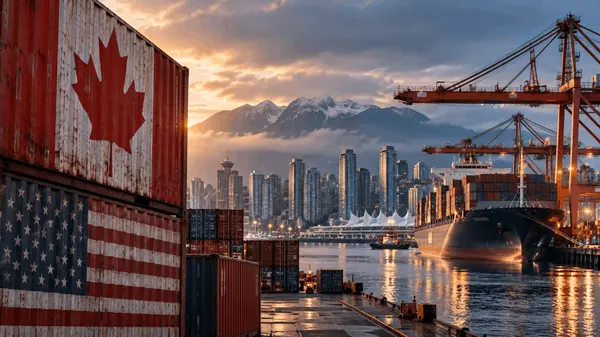
Canada–U.S. trade talks broke down in the early hours of Saturday, August 22, just after an extended deadline expired. The result: a 50% U.S. tariff now applies to about $20 billion worth of Canadian exports.
Prime Minister Mark Carney countered that last-minute changes to the U.S. proposed terms were unfair and uneconomic, and said Canada would match the tariffs dollar-for-dollar while rolling out additional support for affected workers and businesses in the coming days. I'll leave the political back-and-forth to the political commentators — my interest here is narrower and more practical: what does a stalled trade relationship, layered on top of mounting pressure across B.C.'s resource sector, actually do to housing markets like ours?
What Happened on the Sunshine Coast
On August 20, Domtar announced it is indefinitely curtailing operations at its Howe Sound Pulp and Paper mill in Port Mellon, just across the water from Sechelt and Gibsons, affecting approximately 350 jobs. The company points to a global pulp price collapse — prices are approaching their lowest level in 100 years on an inflation-adjusted basis, driven largely by cheaper eucalyptus hardwood pulp flooding in from South America and Southeast Asia.
I want to be precise about this, because it's easy to lump it in with the trade news above: Domtar has not pointed to U.S. tariffs as the reason for this curtailment. The stated cause is global pulp pricing and international competition. It's a separate story that happens to be landing in the same week as the trade breakdown — and together, the two illustrate the same broader pressure on British Columbia's resource economy without one directly causing the other.
The Scale of It
Sechelt Mayor John Henderson called the curtailment "devastating," noting the mill is one of, if not the largest, private-sector employers on the Coast. B.C.'s Minister of Forests, Ravi Parmar, put it plainly: "These are not just jobs, these are livelihoods that have supported families and communities for generations."
This isn't an isolated event. It's the third major B.C. pulp or forestry mill closure or curtailment in under a year, and each one has landed in a community with limited ability to absorb the shock.
- Dec 2025 Domtar closes the Crofton mill on Vancouver Island — 350 jobs lost
- Jul 2026 Canfor shuts the Northwood pulp mill near Prince George — 300 jobs lost
- Aug 20, 2026 Domtar indefinitely curtails operations at Howe Sound Pulp and Paper, Port Mellon — approximately 350 jobs affected
That's close to 1,000 forestry-sector jobs affected in this province in nine months, across three separate announcements — concentrated in exactly the kind of single-industry coastal and interior communities that have the least ability to diversify quickly.
Why This Matters Beyond Sechelt
It's tempting to read a Sunshine Coast mill curtailment as someone else's problem if you're buying or selling in West Vancouver, North Vancouver, or the Sea-to-Sky corridor. I'd push back on that a little — not because prices change tomorrow, but because housing is downstream of the economy, and these are the kinds of signals that eventually work their way through.
The Direct Ripple
- The Sunshine Coast connects to the North Shore through the Horseshoe Bay ferry terminal — many West Van and North Van households have family, weekend property, or long-standing ties there
- Displaced forestry workers and their families sometimes relocate toward the Lower Mainland for work, adding modest pressure to entry-level rental demand
- Regional consumer confidence softens when three mill closures or curtailments make the news in one year — and confidence tends to show up in offer activity before it shows up in the statistics
The Renovation & Construction Angle
- Steel and aluminum tariffs (already substantial under existing U.S. measures, with more now layered on) add a layer of cost uncertainty to renovation and new-construction material budgets
- Softwood lumber and pulp-sector instability adds further uncertainty to supply chains that West Coast builders and renovators rely on
- Trade uncertainty is one of many economic factors the Bank of Canada considers when assessing inflation, economic growth, and interest-rate policy — and interest-rate policy affects mortgage costs for every buyer in our market
As someone who spent nearly four decades in interior design and construction before real estate, I don't watch these stories only as a REALTOR® — I've spent a career on the other side of them, dealing directly with material specifications, purchasing, product availability, construction pricing, lead times, project scheduling, substitutions, and change orders. That background changes how a headline like this reads to me.
I recently completed design work on a 48-unit rental project in Terrace, B.C., and timing material orders was already an important part of how we ran that project — confirming lead times, getting approved products locked in, and staying ahead of purchasing schedules rather than assuming a specified item would still be available, at the same price, when we needed it. With additional mill curtailments and continued trade uncertainty layered on top of that, I'd expect that kind of planning to matter even more, not less. For anyone planning a renovation or construction project right now, I'd be looking closely at lead times, confirming pricing early, and placing approved orders as soon as practical, rather than assuming today's products will be available later at today's cost.
The Affordability Backdrop
British Columbia was already one of the more expensive places in the country to live before this week. Layering close to 1,000 affected forestry jobs and a fresh round of tariffs on top of that squeeze doesn't just affect the households directly involved — it affects the confidence and purchasing power of an entire regional economy that our local market ultimately sits inside.
What Buyers, Sellers, and Homeowners Should Actually Do
- If you're renovating: consider confirming lead times, locking in pricing where appropriate, and placing approved orders as early as practical if a project is already planned. This isn't a call that shortages or price increases are guaranteed — it's a recognition that tariff and supply-chain uncertainty make early procurement planning more valuable than usual.
- If you're watching interest rates: trade uncertainty is one of many factors the Bank of Canada weighs when it assesses inflation, growth, and rate policy. It's worth watching, but not something I'd treat as predictive on its own.
- If you're selling in a resource-dependent community: price with the local economic reality in mind — buyer confidence in single-industry markets tends to soften faster than it does here.
- If you're buying on the North Shore or in Sea-to-Sky: our market isn't insulated from provincial economic sentiment, but it also isn't a single-industry market. If renovation potential is part of your purchase thesis, extend your due diligence to material and construction cost trends, not just mortgage rate assumptions.
My Read
I don't have a tidy conclusion for this one, and I don't think anyone honestly does yet. Nothing about this week means West Vancouver or North Vancouver prices shift tomorrow — they won't, and I'd be doing you a disservice if I implied otherwise. What I do know is that close to 1,000 forestry jobs being affected in this province in nine months, on top of a trade relationship that just took a real step backward, is not background noise for anyone who cares about British Columbia's economy. Housing is downstream of the economy, always — it just takes time to show up.
For the families on the Sunshine Coast facing this directly, my thoughts are with you — some of you are friends and clients, and I know this isn't an abstraction. For everyone else reading this from West Vancouver, North Vancouver, or further up the Sea-to-Sky corridor, it's worth watching this story closely over the next few months rather than assuming it stays someone else's news.
If you want to talk through how any of this intersects with a renovation you're planning, a purchase you're considering, or a sale you're timing, that's exactly the kind of conversation I'm glad to have.
Frequently Asked Questions
Common questions about the trade deal collapse, the Howe Sound mill curtailment, and what it means for buyers and sellers on the North Shore.
What exactly happened at the Sunshine Coast mill, and why?
Domtar's Howe Sound Pulp and Paper mill in Port Mellon, near Sechelt, announced on August 20, 2026 that it is indefinitely curtailing operations, affecting approximately 350 jobs. The company cites a collapse in global pulp prices — near their lowest level in a century, adjusted for inflation — driven by cheaper eucalyptus pulp imports undercutting demand for B.C. softwood pulp. This is described as an indefinite curtailment, not a confirmed permanent closure.
Is the mill curtailment caused by the U.S. tariffs?
Not according to Domtar. The company has attributed the curtailment primarily to global pulp pricing and international competition, not U.S. tariffs specifically. It landed in the same week trade talks collapsed and new tariffs took effect, and both stories reflect the same broader trade and economic pressure facing B.C.'s resource sector — but one should not be read as directly causing the other. They're related as signals, not as cause and effect.
What happened with the Canada–U.S. trade talks?
Negotiations broke down in the early hours of August 22, 2026, after an extended deadline expired. A 50% U.S. tariff now applies to roughly $20 billion of Canadian goods. Prime Minister Carney has said Canada will match the tariffs dollar-for-dollar and announce further support for affected workers and businesses.
Will this affect renovation costs on the North Shore?
Possibly, but I'd stop short of predicting it with certainty. Tariffs on steel and aluminum add real uncertainty to pricing for railings, structural steel, windows, and certain appliance categories, and forestry-sector disruption adds uncertainty to lumber supply chains. If you have a renovation planned, it's worth confirming lead times and locking in pricing where appropriate rather than assuming today's costs and availability will hold.
Does a Sunshine Coast mill curtailment really affect West Vancouver real estate?
Not in a direct, measurable way on tomorrow's MLS® statistics — I wouldn't want to overstate that connection. But regional employment trends, consumer confidence, and the broader economic conditions the Bank of Canada considers in its rate decisions do factor in signals like this over time. Our market is more diversified than a single-industry community, but it isn't disconnected from the province's overall economic health.
How many forestry jobs has B.C. lost recently?
Adding up three separate announcements — Howe Sound (approximately 350 jobs, August 2026), Canfor's Northwood pulp mill near Prince George (300 jobs, July 2026), and Domtar's Crofton mill on Vancouver Island (350 jobs, December 2025) — the province has seen close to 1,000 forestry and pulp-sector jobs affected in roughly nine months.
Sources
- CBC News — "B.C.'s Howe Sound Pulp and Paper announces mill operations stopping indefinitely," August 2026. cbc.ca
- Global News — "Domtar 'indefinitely curtailing' Howe Sound pulp mill," August 2026. globalnews.ca
- Coast Reporter — "Howe Sound Pulp and Paper Mill closing indefinitely," August 2026. coastreporter.net
- Domtar — Official press release, "Howe Sound mill operations indefinitely idled." domtar.com
- Canada's National Observer — "300 jobs lost as Canfor closes a pulp mill outside Prince George, BC," July 2026. nationalobserver.com
- NPR — "U.S.-Canada trade talks collapse just before deadline for tariffs," August 22, 2026. npr.org
Debbie Evans | REALTOR® & Registered Interior Designer
eXp Realty | West Vancouver, North Vancouver, Vancouver, Squamish & Whistler
With nearly 40 years of combined experience in interior design, construction, and real estate, I bring a dual lens to market commentary — reading economic and material-cost trends alongside price data. If you'd like to talk through how any of this affects a renovation, purchase, or sale you're planning, I'm glad to have that conversation.
This content is for informational purposes only and does not constitute financial, legal, or investment advice. All figures and quotes are sourced from the publicly available news reporting and government/company statements listed above, current as of August 22, 2026. Economic conditions referenced here — tariff rates, employment figures, and trade negotiations — remain fluid and subject to change.
Categories
- All Blogs (103)
- aboriginal title ruling (2)
- B.C. Policy (1)
- bc housing market (24)
- bc real estate (56)
- Bill C-15 (1)
- build canada homes (10)
- Buyers Guide (4)
- canada strong fund (4)
- Canada-U.S. Trade (2)
- canadian real estate (16)
- Canadian Real Estate & Housing (1)
- Climate Change (2)
- Cost of Living (2)
- Design & Build (4)
- Dundarave West Vancouver (1)
- Equity Growth (1)
- Federal Policy (1)
- freehold (1)
- Home Buying Tips (1)
- Household Debt (1)
- housing policy (1)
- land claims (2)
- Land Claims / BC Real Estate (1)
- leasehold (1)
- local news (1)
- Lower Lonsdale (2)
- Market & Policy Analysis (1)
- Market Commentary (6)
- market insights (23)
- Market Intelligence (1)
- Mortgage Delinquencies (1)
- Mortgage Renewals (1)
- Multigenerational Living (2)
- North Vancouver Real Estate (19)
- open house (1)
- Open House Security (1)
- presale (1)
- real estate insights (7)
- Real Estate Market & Housing (2)
- renovation (1)
- Squamish Market Update (7)
- squamish real estate (8)
- squamish update (3)
- Vancouver Real Estate (17)
- West Vancouver Living (15)
- West Vancouver Real Estate (26)
- Whistler Market Update (4)
Recent Posts







Have a Question? Let’s Talk. I’m Here to Help.

North Shore & Vancouver Realtor License ID: 175378
+1(778) 875-4934 | debbie.evans@exprealty.com