
Three Structural Signals That Could Shape Vancouver Real Estate in 2026
Three Structural Signals That Could Shape Vancouver Real Estate in 2026
Andrew Liss, Chief Economist at Greater Vancouver REALTORS®, recently released the 2026 Residential Outlook — and the structural signals are worth attention.
This is not a typical monthly update.
It highlights three structural shifts that have not occurred together in modern market history.
1️⃣ Shadow Inventory Near 30% — Double Historical Norms
Shadow inventory refers to completed but unsold new homes — primarily condos and townhomes — that compete directly with resale listings.
Historically, this category has represented a relatively modest share of total available supply — often in the range of 10–15%, occasionally moving closer to 20%.
Today, it is approaching 30% of total available inventory.
That means nearly one in three available homes may be newly built and unsold.
We have not operated at this level in modern market cycles.
When shadow inventory doubles historical norms:
• Developers compete more aggressively
• Incentives expand
• Resale listings face added pricing pressure
• Sustained price acceleration becomes structurally harder
This is not a headline statistic.
It is a supply signal.
2️⃣ Population Growth Went Vertical — Now It’s Slowing
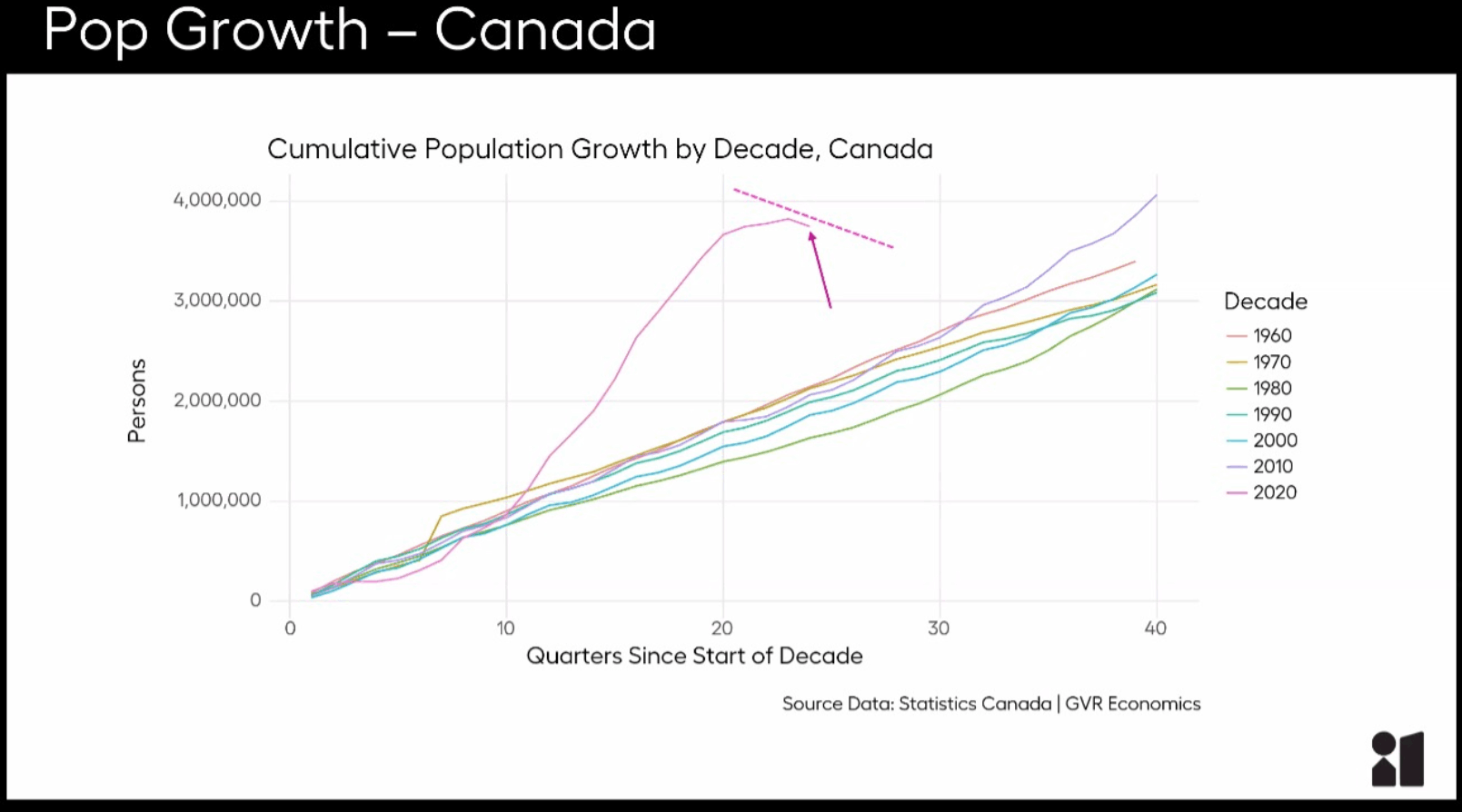
For decades — from the 1960s through the 2000s — Canada’s population growth followed steady, predictable patterns.
Each decade added roughly 3 million people.
Then the early 2020s changed the slope dramatically.
In just a few years, Canada added nearly 4 million people — a pace not seen in modern history.
The graph doesn’t gradually rise.
It spikes.
That surge fueled:
• Rental demand
• First-time buyer pressure
• Investor activity
• Rapid price escalation during and after COVID
Now immigration targets have been reduced and population growth is flattening — and in some provinces, turning negative on a net basis.
We have shifted from accelerating demographic tailwinds to demand normalization.
That is a structural change.
3️⃣ Mortgage Renewals Meet Slowing Momentum
Many homeowners who purchased or refinanced during ultra-low COVID rates are now entering renewal cycles at materially higher interest rates.
At the same time:
• Population growth is slowing
• Supply remains elevated
• Investor appetite has cooled
This combination has limited historical precedent.
How This Compares to Toronto
Toronto’s condo market has already experienced what happens when:
• New supply expands aggressively
• Investor demand cools
• Absorption slows
The result has been price softness and elevated inventory in the condo segment.
Vancouver is not Toronto.
However, rising shadow inventory combined with slowing population growth is a supply-demand shift worth watching carefully.
What This Means for Vancouver & The North Shore
This is not a crash forecast.
It is a recalibration signal.
When supply increases and demand normalizes:
• Buyers gain leverage
• Selling timelines extend
• Pricing becomes more strategic
• Incentives become more common
This is a precision market — not a frenzy market.
If you would like a breakdown of how these structural trends apply specifically to your property type or neighbourhood, I’m happy to provide a personalized analysis.
The full 2026 Residential Outlook presentation is worth watching for anyone serious about understanding where we are headed.
Presentation courtesy of Greater Vancouver REALTORS®
Featuring Andrew Liss, Chief Economist
Debbie Evans, REALTOR®
Debbie Evans Personal Real Estate Corporation
eXp Realty
Categories
- All Blogs (103)
- aboriginal title ruling (2)
- B.C. Policy (1)
- bc housing market (24)
- bc real estate (56)
- Bill C-15 (1)
- build canada homes (10)
- Buyers Guide (4)
- canada strong fund (4)
- Canada-U.S. Trade (2)
- canadian real estate (16)
- Canadian Real Estate & Housing (1)
- Climate Change (2)
- Cost of Living (2)
- Design & Build (4)
- Dundarave West Vancouver (1)
- Equity Growth (1)
- Federal Policy (1)
- freehold (1)
- Home Buying Tips (1)
- Household Debt (1)
- housing policy (1)
- land claims (2)
- Land Claims / BC Real Estate (1)
- leasehold (1)
- local news (1)
- Lower Lonsdale (2)
- Market & Policy Analysis (1)
- Market Commentary (6)
- market insights (23)
- Market Intelligence (1)
- Mortgage Delinquencies (1)
- Mortgage Renewals (1)
- Multigenerational Living (2)
- North Vancouver Real Estate (19)
- open house (1)
- Open House Security (1)
- presale (1)
- real estate insights (7)
- Real Estate Market & Housing (2)
- renovation (1)
- Squamish Market Update (7)
- squamish real estate (8)
- squamish update (3)
- Vancouver Real Estate (17)
- West Vancouver Living (15)
- West Vancouver Real Estate (26)
- Whistler Market Update (4)
Recent Posts








Have a Question? Let’s Talk. I’m Here to Help.

North Shore & Vancouver Realtor License ID: 175378
+1(778) 875-4934 | debbie.evans@exprealty.com