
Budget 2026 Fourplex and Mortgage Changes: What They Mean for the North Shore
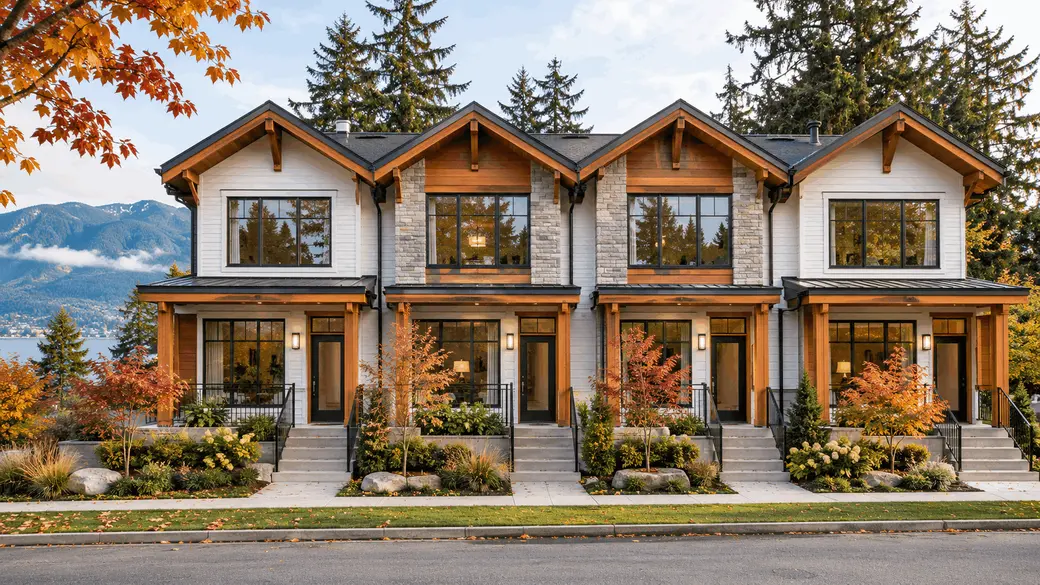
Budget 2026 Fourplex and Mortgage Changes: What They Mean for the North Shore
The federal budget tabled on November 5, 2026 opens new financing routes for small builders, rental developers and home buyers: insured construction and purchase financing for newly built three- and four-unit properties with no owner-occupancy requirement, a private-insurer product for 5–50 unit rentals, and a proposal to widen optional mortgage insurance for first-time and new-build buyers.
Each opportunity comes with eligibility conditions, start dates and risks that headlines tend to skip. Some measures start on February 1, 2027, some are still proposals, and a mortgage-insurance rule is not a building permit. This article checks the measures against Finance Canada, CMHC, published insurer premium schedules and the Government of BC, shows the arithmetic, and says where something is unconfirmed.
The Six Changes at a Glance
Before the detail, here is how I would sort what was announced into what is already in force, what starts on a set date, and what is still only proposed.
Existing rule, proposed change, who it affects and where it stands
| Topic | Existing rule | Proposed or announced change | Who it affects | Date and status |
|---|---|---|---|---|
| New 3–4 unit homes | Insured loans on 1–4 unit homes are for owner-occupied properties, capped at $1.5M value. CMHC’s separate small-rental product (non-owner-occupied, 2–4 units) tops out at 80% loan-to-value. | Up to 90% of projected value on completion, no owner-occupancy requirement, no maximum value, up to 30-year amortization, for construction or purchase of new 3–4 unit properties. | Small builders, investors buying new 3–4 unit buildings | Applications submitted by lenders from Feb 1, 2027. Parameters published by Finance Canada Nov 5, 2026. |
| 5–50 unit rentals | CMHC insures multi-unit rentals (standard and MLI Select). | Private mortgage insurers may also insure 5–50 unit properties: up to 90% (new construction) or 85% (other), up to 50 or 40 years. | Rental developers and owners, lenders | From Feb 1, 2027. These are maximums; no insurer products had been published in the sources reviewed as of Nov 14, 2026. |
| Optional insurance price cap | Optional (low-ratio) insurance is limited to homes under $1M. | Raise the cap to $1.5M, with 30-year amortization when a borrower is a first-time buyer or the home is newly built. | Buyers with 20%+ down | Proposed in Budget 2026. No start date in the sources reviewed. |
| High-ratio insurance cap | Insured mortgage price cap is already $1.5M (since Dec 15, 2024). | No change. | Buyers with under 20% down | In force. |
| 30-year insured amortization | Available to first-time buyers and buyers of new builds (since late 2024), with a 0.20% premium surcharge. | No change for high-ratio loans. Proposed extension to the optional-insurance product. | First-time and new-build buyers | In force for high-ratio; extension proposed. |
| Federal foreign-buyer ban | In force to Jan 1, 2027. | Extend the ban on foreign purchases of existing residential property to Jan 1, 2029 and exempt “new residential properties”, which the budget text reviewed does not define. | Non-Canadian buyers; developers; presale buyers | Proposed. Legislation and regulations still to come. Current rules apply until then. |
Sources: Finance Canada, “Mortgage Insurance Rule Changes to Support Missing Middle Housing” (Nov 5, 2026); Finance Canada, “The Boldest Mortgage Reforms in Decades” (Sept 2024); CMHC small-rental premium schedule; Fasken, Budget 2026 foreign-buyer bulletin; GVR and BCREA budget summaries. Checked November 14, 2026.
1. Fourplexes: What Actually Changed
The opportunity. For newly built three- and four-unit properties, Finance Canada’s published parameters would allow insured financing of up to 90% of projected value on completion, with no owner-occupancy requirement and no maximum property value, for either construction or purchase. For a small builder or investor, that could reduce the equity needed to start. The conditions: the property must be newly built, it must have three or four units, and it does not cover duplexes or older buildings.
- No owner-occupancy requirement. Confirmed. Finance Canada lists none for either new product. The budget’s own example is a $3M fourplex that, under today’s rules, would exceed the $1.5M cap and require the builder to live in one unit.
- No maximum property value. Confirmed for the 3–4 unit and 5–50 unit products.
- Financing up to 90%. The new ceiling is 90% of projected property value upon completion, which is a different number from 90% of what you spend. For an investor who will not live in the building, CMHC’s existing small-rental product tops out at 80% loan-to-value.
- Amortization up to 30 years. This is the maximum for completed properties. Thirty-year insured amortizations already exist for first-time buyers and new-build buyers, so the headline is less new than it sounds for those borrowers.
Construction financing versus completed-property rules
The product allows two loan uses: construction of a new three- or four-unit property, and purchase of a newly built one. Finance Canada lists the following parameters for the completed property: a 30-year maximum amortization, gross and total debt-service ratios of 39% and 44% at the minimum qualifying rate, and a credit score of 600 or higher for at least one borrower or guarantor.
For construction financing, Finance Canada’s page treats things differently. Under both products it sets no maximum amortization and no minimum debt-coverage or debt-service requirement, and says insurers will apply their own corporate underwriting. The completed-property limits should therefore not be read as universal rules for construction loans. How a lender and insurer test a borrower during construction, and how they move to the completed-property tests, is something to confirm with them directly.
Do Not Assume
Qualifying to buy a finished fourplex on a 30-year insured mortgage does not mean your construction draws come on the same terms. Draw schedules, holdbacks, guarantees and cost-to-complete tests are set by the lender and insurer. As of November 14, 2026, no insurer construction-loan product for this program was published in the sources reviewed, so treat the 90% as a ceiling, not an offer.
Which insurers, and when do lenders start?
Finance Canada says the measures apply to insurance applications that lenders submit on or after February 1, 2027. Its page refers to “mortgage insurers” generally for the 3–4 unit product and does not name CMHC, Sagen or Canada Guaranty. No premium schedules or lender announcements were located in the sources reviewed. That is the gap to watch between now and February.
Owner-occupied is not the same as owner-builder
These two get mixed up constantly. A lender or insurer’s owner-occupancy requirement asks whether the borrower will live in the property. That is what the federal change removes for new 3–4 unit buildings.
BC’s Owner Builder Authorization is a licensing exemption under the Homeowner Protection Act. It lets an individual build a home for personal use without a licensed residential builder. BCFSA guidance says the owner-builder must live in the home for the first year, cannot sell or rent it during that year, and must give buyers an Owner Builder Disclosure Notice for ten years afterwards. A small developer who intends to rent or sell a fourplex is not in that category. Confirm your exact path with BC Housing before you buy land.
What this could mean for a small builder
With nearly 40 years across design, construction and real estate, I will be direct: financing is only one of several constraints. Federal insurance eligibility says nothing about:
- Zoning. Whether a lot can take four units is a municipal and provincial land-use question.
- Subdivision or strata. Selling units individually usually means strata or fee-simple subdivision. Keeping all four as rental does not.
- Permits, servicing and development charges. These add time and carrying cost, and they come due before the first draw.
- Feasibility. Land cost, trade pricing, soft costs and a realistic schedule decide whether the project works. A project-specific budget matters more than any national parameter.
The change lowers one barrier. It does not remove the others.
2. Fourplex Financing: Equity, Profit and Risk
Higher loan-to-cost financing can reduce the cash a builder needs at the start. How much it reduces it, and what it does to returns, depends on costs that sit outside the construction budget. This section works through one illustrative financing model with an explicit payment schedule. It is not a representation of any available lender or insurer product.
What the $5.1M base cost includes and excludes
| Item | Amount (assumed) | |
|---|---|---|
| Included in $5.1M | Land | $1,900,000 |
| Included in $5.1M | Soft costs (assumed split: $400,000 at the start, $200,000 over the first six months) | $600,000 |
| Included in $5.1M | Hard costs, including contingency (spread evenly over 18 months) | $2,600,000 |
| Base development cost | $5,100,000 | |
| Excluded from $5.1M, modelled | Lender fee (1.0% of loan), insurance premium (assumed 1.5% of loan), construction interest (6.0%), selling costs (2.5% of sale price) | See Visual 2 |
| Excluded, not modelled | GST and other taxes, holding costs other than interest (such as insurance and property taxes during the build), legal, appraisal and cost-consultant fees, interest reserves or holdbacks a lender may require, and income tax | Unknown |
Loan-to-value or loan-to-cost?
Finance Canada’s parameter is a percentage of projected property value on completion. Comparing percentages of cost gives a different number. With an assumed $5.8M of projected sale value:
The published LTV ceiling alone does not establish how much this project could borrow. The lender and insurer must confirm eligible valuation, costs, draw limits and other underwriting conditions. For this illustration only, I assume the loan is 80% or 90% of the $5.1M base cost. That is a modelling assumption, not a program rule.
The base funding gap is not the cash required
80% of cost: $5,100,000 − $4,080,000 = $1,020,000
90% of cost: $5,100,000 − $4,590,000 = $510,000
Those two numbers are only the gap between base cost and the assumed loan. They are the starting point, not the total cash a builder would need, because fees, premiums and construction interest also have to be paid.
The payment schedule in the model
- Month 0 (March 2027). Land and the first $400,000 of soft costs ($2.3M) are paid. Equity goes in first until the base funding gap is covered, then the loan funds the rest. The lender fee and insurance premium are paid in cash, not financed.
- Months 1–18. Remaining soft costs and hard costs are paid by loan draws until the loan is fully used. Interest on the prior month’s balance is paid in cash each month and not added to the loan.
- Months 19–24 (sales period). Interest continues on the full loan. Assumed lender arrangement: this interest is deferred and paid from closing proceeds, together with selling costs and the loan repayment. No lender or insurer has confirmed that arrangement for this program. If a lender requires monthly payments instead, see the alternative below.
- Overruns. Any cost beyond what the fixed loan covers is paid from additional equity.
80% versus 90% of cost financed: cash required, profit and return
| Line | 80% of cost | 90% of cost |
|---|---|---|
| Assumed loan | $4,080,000 | $4,590,000 |
| Base funding gap (equity at the start) | $1,020,000 | $510,000 |
| + Lender fee, paid in cash at month 0 | $40,800 | $45,900 |
| + Insurance premium (assumed), paid in cash at month 0 | $61,200 | $68,850 |
| + Construction interest, paid in cash months 1–18 | $240,200 | $286,100 |
| Total equity contributed (all paid before the sale closes, so also peak cash) | $1,362,200 | $910,850 |
| Sale revenue (assumed) | $5,800,000 | $5,800,000 |
| − Selling costs (2.5%), from proceeds | $145,000 | $145,000 |
| − Interest during the sales period, from proceeds | $122,400 | $137,700 |
| − Loan repayment, from proceeds | $4,080,000 | $4,590,000 |
| Net cash returned to the owner | $1,452,600 | $927,300 |
| Profit (net cash returned − total equity contributed) | $90,400 | $16,450 |
| Simple return = profit ÷ total equity contributed | 6.6% | 1.8% |
| Annualized return (dated cash flows) | about 3.5% | about 1.0% |
Method: the denominator for the simple return is total equity contributed, shown in bold above, not the base funding gap. Financing costs are counted once: fee, premium and interest are paid from the cash and proceeds lines shown and are not repeated in a separate cost line. Profit equals sale revenue, less selling costs, less the $5.1M base cost, less total financing costs ($464,600 at 80%, $538,550 at 90%). The annualized figure is an XIRR on dated monthly cash flows (equity paid in the months shown, starting March 1, 2027; net proceeds received March 1, 2029), using actual days over a 365-day year. Assumptions (illustrative): $5.1M cost and $5.8M sale value; 18-month build and 6-month sales period; rate, fee, premium and selling costs are placeholders because no insurer has published premiums for this program. Not a quote, forecast or lender product. Calculation: Debbie Evans, November 14, 2026.
If sales-period interest is paid monthly instead
Paying months 19–24 interest in cash each month adds it to contributed equity and peak cash. Profit does not change, because the same interest is simply paid earlier, but the returns do:
| If sales-period interest is paid monthly | 80% of cost | 90% of cost |
|---|---|---|
| Total equity contributed = peak cash | $1,484,600 | $1,048,550 |
| Profit (unchanged) | $90,400 | $16,450 |
| Simple return (profit ÷ total equity contributed) | 6.1% | 1.6% |
| Annualized return (dated cash flows) | about 3.5% | about 1.0% |
That is $28,550 above the $1,020,000 base gap for a single 90% project.
What this comparison shows, and what it does not
One Hypothetical Project, Not a General Rule
These profit and return figures describe this particular hypothetical project, with its assumed costs, sale price, rate, fees and premium. They are not a general conclusion that 90% financing is worse than 80%. Whether extra leverage helps depends on the project’s margin, the all-in cost of borrowing and the actual terms a lender and insurer offer. With a wider margin or cheaper debt, the same comparison can favour 90%.
In this model, moving from 80% to 90% of cost cuts the cash needed by about $451,000 (not $510,000), because the extra debt also carries more fees, premium and interest. It adds about $73,950 of financing cost, which takes profit from $90,400 to $16,450.
80%: $90,400 ÷ $1,362,200 = 6.6% | 90%: $16,450 ÷ $910,850 = 1.8%
Extra leverage lifts the return on your own cash only when the project earns more than the debt costs. In this model the 90% case pulls ahead of the 80% case only if the sale price is above roughly $5.94M, about 2% higher than the $5.8M assumed. At $6.2M, for example, the same model gives about 35% on contributed equity at 80% and about 45% at 90%.
What a bad year does to it
The same model under stress shows how thin the margin is.
Baseline, higher rate, delay, higher costs and lower sale prices
| Scenario | Total equity (80%) | Profit (80%) | Return (80%) | Total equity (90%) | Profit (90%) | Return (90%) |
|---|---|---|---|---|---|---|
| Baseline | $1,362,200 | $90,400 | 6.6% | $910,850 | $16,450 | 1.8% |
| Rate +1 point (7.0%) | $1,402,233 | $29,967 | 2.1% | $958,533 | −$54,183 | −5.7% |
| 6-month delay (24-month build) | $1,445,600 | $7,000 | 0.5% | $1,009,550 | −$82,250 | −8.1% |
| Hard costs +10% ($260k, equity-funded) | $1,632,744 | −$180,144 | −11.0% | $1,181,394 | −$254,094 | −21.5% |
| Sale price −5% ($5.51M) | $1,362,200 | −$192,350 | −14.1% | $910,850 | −$266,300 | −29.2% |
| Sale price −10% ($5.22M) | $1,362,200 | −$475,100 | −34.9% | $910,850 | −$549,050 | −60.3% |
Assumptions: same as Visual 2; return is profit divided by total equity contributed in that scenario. The loan is fixed at its base amount, so overruns are paid from added equity. The delay case lengthens the build to 24 months with the same hard-cost budget and adds interest and no other holding costs, which understates real delay costs. Profit reaches zero at a sale price of about $5.71M (80%) or about $5.78M (90%). Sale proceeds would only just repay the loan and accrued interest at about $4.31M (down roughly 26%) at 80%, or about $4.85M (down roughly 16%) at 90%. Calculation: Debbie Evans, November 14, 2026.
What This Shows
In this model the $700,000 gap between sale revenue and base cost is about a 14% margin on cost, and financing and selling costs take most of it. Higher leverage can magnify percentage losses on equity and increase financing exposure: in the 5% lower sale-price case the loss is 14.1% of contributed equity at 80% financing and 29.2% at 90%, and a larger loan also means more interest and a bigger balance to repay from a weaker sale.
Could released equity fund a second fourplex?
The base funding gap makes it look possible: $510,000 per project at 90% means $1,020,000 would cover two. But the gap is not the cash required. In the model, one project at 90% needs $910,850 of cash before the sale closes, and one project at 80% needs $1,362,200.
Two at 80%: 2 × $1,362,200 = about $2.72M
On these assumptions, $1,020,000 does not support two simultaneous projects. It would cover one project at 90% with about $109,000 left (or short by about $28,550 if sales-period interest is paid monthly), and a 10% hard-cost overrun alone would add about $270,000 to the cash needed. Several requirements remain unknown and would raise the cash needed further:
- Lender and insurer requirements. No construction product for this program appears in the sources reviewed. A lender may look at total exposure and ask for guarantees; confirm with a lender.
- Costs not modelled. GST, holding costs other than interest, professional fees and any required interest reserve or holdback.
- Timing. A second project funded from the first project’s sale proceeds is a different, sequential plan, and depends on the first sale closing near its assumed price.
- Capacity. Trades, permits and your own time do not double with your borrowing power.
The Honest Limit
More leverage does not by itself mean more projects or more profit. Higher leverage can magnify percentage losses on equity and increase financing exposure, and the cash a project really needs is higher than the gap between cost and the loan.
3. Purpose-Built Rentals: 5 to 50 Units
Keep this separate from fourplex financing. It is a different product, with different borrower tests, aimed at a different builder.
2–4 units versus 5–50 units: what is verified
| Feature | Existing 2–4 units (owner-occupied) | Existing 2–4 units (non-owner-occupied rental, CMHC) | New 3–4 units (from Feb 1, 2027) | New 5–50 units, private insurers (from Feb 1, 2027) |
|---|---|---|---|---|
| Maximum loan-to-value | Insurer schedules run to 95%; confirm the maximum for 3–4 units | 80% | 90% of projected value on completion | 90% new construction; 85% other |
| Maximum amortization | 25 years; 30 for first-time and new-build buyers | Not confirmed in sources reviewed | 30 years (completed property); none set for construction financing on the Finance page | 50 years new construction; 40 other (not set for construction financing) |
| Owner must live there? | Yes | No | No | No |
| Maximum property value | $1.5M | Not stated in sources reviewed | None | None |
| Uses | Purchase and related | Purchase and related | Construction; purchase of newly built | Construction, purchase, refinance, renewal |
| Borrower tests | Standard high-ratio rules | Standard | Completed property: GDS 39%, TDS 44% at minimum qualifying rate; credit score 600+ (one borrower or guarantor). Construction financing: no minimum debt-service requirement set on the Finance page. | Debt coverage ratio 1.15 (5-yr term) or 1.10 (10-yr); net worth at least 25% of loan, minimum $100,000, Canadian assets only. No minimum debt-coverage requirement set for construction financing. |
| Construction-loan terms | n/a | n/a | No maximum amortization or debt-service test on the Finance page; each insurer applies its own underwriting | No maximum amortization or debt-coverage test on the Finance page; each insurer applies its own underwriting |
| Property definition | 1–4 units | 2–4 units | New 3–4 unit eligible property | 5–50 self-contained units, single legal title; cannot be assembled from separately titled parcels |
Sources: Finance Canada backgrounder (Nov 5, 2026); CMHC premium information for homeowner and small rental loans; Finance Canada (Sept 2024). Cells marked “not confirmed” are gaps in the sources reviewed, not rules. Checked November 14, 2026.
Maximum terms are not the same as products
Finance Canada has published the maximum parameters private insurers may use. The sources reviewed include no insurer premium schedule or product sheet for the 5–50 unit program, and no list of lenders that will accept it, as of November 14, 2026. A cap of 50 years is permission, not availability.
How it compares with CMHC
This is the part I would be most careful with. CMHC already offers 50-year amortizations for new construction under its standard rental product, so 50 years is not new to the market. CMHC’s MLI Select awards points for affordability, energy efficiency and accessibility. At its top tier it allows up to 95% financing and 50 years, with limited recourse. The new private product tops out at 90% for construction.
The private route may carry fewer MLI Select-style restrictions, because private insurers do not have to require affordability commitments. But no product conditions are published yet, so treat that as an open question, not a finding.
Cash flow, not just the loan amount
A lender sizes a rental loan on income. The debt coverage ratio is net operating income divided by annual debt service. Net operating income is rent less vacancy and operating costs. A longer amortization lowers the payment, but it also raises the total interest.
Example: $4.0M loan at an illustrative 5.5%
| Amortization | Monthly payment | Annual debt service | Total interest over the full amortization | Net operating income needed for 1.15 |
|---|---|---|---|---|
| 40 years | $20,462 | $245,549 | $5.82M | $282,000 |
| 50 years | $19,415 | $232,978 | $7.65M | $268,000 |
Stretching from 40 to 50 years cuts the annual payment by about $12,600, roughly 5%. It adds about $1.8M of total interest if the loan runs the full amortization period. A longer amortization lowers the monthly strain. It does not lower the total cost of borrowing. And vacancy matters: if rents come in below plan, a building that looks fine at 1.15 can fall short quickly.
Assumptions: 5.5% nominal rate is illustrative only, semi-annual compounding, monthly payments, loan held to the end of the amortization period (the loan term, and so the renewal rate, is a separate matter). Rates will differ. Calculation: Debbie Evans, November 14, 2026.
4. Buyer Mortgages and Optional Insurance
Three different things get lumped together here, so I will separate them.
- High-ratio insurance (under 20% down). Required by law. The price cap has been $1.5M since December 15, 2024.
- Optional low-ratio insurance (20% or more down). A lender can buy it so a borrower may get a better rate. The proposal raises its price limit from $1M to $1.5M. This is the genuinely new proposal. No start date has been announced in the sources reviewed.
- 30-year amortization. Already available on insured mortgages for first-time buyers and for anyone buying a newly built home, with a 0.20% premium surcharge. The proposal would apply the same eligibility to the optional product. A repeat buyer purchasing a resale home would not qualify.
Recalculating the $1.25M example
Consider a $1.25M purchase with $250,000 down, a $1M base mortgage, a $24,000 premium added to the loan, and 30-year amortization. Canadian fixed mortgages compound semi-annually, which I applied here.
Uninsured versus insured, $1.25M purchase, 20% down
| Line | Uninsured | Insured (premium $24,000) | Insured (premium $26,000) |
|---|---|---|---|
| Base mortgage | $1,000,000 | $1,000,000 | $1,000,000 |
| Financed premium | $0 | $24,000 | $26,000 |
| Total loan | $1,000,000 | $1,024,000 | $1,026,000 |
| Illustrative rate | 5.14% | 4.69% | 4.69% |
| Monthly payment | $5,421 | $5,277 | $5,287 |
| Difference | — | $144 lower | $134 lower |
| Balance after 5 years | $919,399 | $935,488 | $937,315 |
| Total interest if held 30 years at the same rate | $951,481 | $875,699 | $877,410 |
Assumptions: rates are illustrative, not current offers. The $24,000 premium is 2.40% of $1M, the same as CMHC’s published 25-year rate for 75.01–80% loan-to-value. A 30-year amortization adds 0.20% on the high-ratio schedule, which would make it $26,000. Premium pricing for the proposed optional product has not been published, so both figures are assumptions. Break-even insured rate: about 4.93% with the $24,000 premium and about 4.91% with $26,000. Semi-annual compounding, monthly payments. Calculation: Debbie Evans, November 14, 2026.
What I would not promise
I will not promise $144 a month, and I would not multiply it by 360 and call it a lifetime saving. Three reasons:
- The rate gap is an assumption. With the $24,000 premium, the insured payment equals the uninsured payment at an insured rate of about 4.93% (a gap of roughly 0.21 points). A lower insured rate gives a lower payment, and a higher rate gives a higher one. At 4.69% the saving is $144. At 4.94% the insured payment is already about $8 a month higher.
- The insured borrower owes about $16,000 more after five years because the premium was financed.
- Renewal rates and future rate spreads between insured and uninsured pricing are unknown. If both loans renewed at 5.14% for the remaining 25 years, the insured payment would be about $5,516 against $5,421. Any 30-year comparison assumes the same spread for decades, which nobody can know.
$5,421 − $5,277 = $144 at a 0.45-point gap → about $0 at a 0.21-point gap (4.93%) → negative if the insured rate is higher
5. Foreign Buyers and New Construction
Budget 2026 (Chapter 3) proposes two changes. The federal ban on foreign purchases of existing residential property would be extended by two years, to January 1, 2029 (the current end date is January 1, 2027). And new residential properties would be exempt. The budget says legislation and a regulatory process will follow. The text reviewed does not define “new residential property” or give an effective date for the exemption, which Fasken’s budget bulletin also notes. Until legislation and regulations arrive, the current rules apply.
Three distinctions that matter
- Federal ban versus BC tax. They are separate systems. The federal measure is a purchase prohibition. BC’s additional property transfer tax is a provincial tax on foreign entities and taxable trustees, and the budget does not change it.
- Existing versus new. The proposal distinguishes existing residential properties (ban extended) from new ones (exempt, once defined). It does not by itself address how a presale, an assignment or a completed but unsold home is classified.
- Which properties the federal Act covers. The federal Act defines residential property as a building with up to three dwelling units, plus condominium units, in census metropolitan areas and agglomerations. Buying an entire four-unit building falls outside the “up to three dwelling units” part of that definition. A separately titled strata unit in a four-unit strata complex is a condominium unit, however, and can be covered where it sits in one of those areas. Confirm how a specific purchase is classified with a lawyer.
What is still undefined
Some summaries present outcomes with more confidence than the budget does. Treat each of these as unresolved:
- Whether a presale, bought before completion, counts as “new”.
- Whether an assignment of a presale contract is included.
- How a never-occupied detached house or a completed but unsold condo is treated.
- The effective date.
Federal restrictions versus BC taxes: two separate systems
| Federal prohibition | BC additional property transfer tax | |
|---|---|---|
| What it is | A ban on certain purchases of residential property by non-Canadians | A tax paid by foreign nationals, foreign corporations and taxable trustees |
| Applies to | Residential property with up to three dwelling units, plus condo units, in census metropolitan areas and agglomerations. Buying a whole four-unit building is outside the “up to three units” limb; a separately titled strata unit is a condo unit and can be covered. | 20% of fair market value in the Capital, Fraser Valley, Metro Vancouver, Central Okanagan and Nanaimo regional districts |
| Budget 2026 proposal | Extend the ban on existing residential property to Jan 1, 2029; exempt “new residential properties” (undefined in the text reviewed) | No change announced |
| New construction | Exemption proposed, not law | BC page does not address new construction or presales; check its pre-sold strata page |
| Status | Current rules continue until legislation passes | In force (BC page last updated June 20, 2025) |
| Where to check | Finance Canada; CMHC | Government of BC property transfer tax pages |
Sources: Fasken (Budget 2026 foreign-buyer bulletin); CMHC, Prohibition on the Purchase of Residential Property by Non-Canadians Act; Government of BC, Additional Property Transfer Tax. Checked November 14, 2026. This is information, not legal advice.
Keep These Separate
Even if the federal exemption becomes law, BC’s 20% additional tax is a provincial decision and the budget did not change it. On a $1,000,000 purchase in Metro Vancouver, that is $200,000 on top of the regular property transfer tax, with refunds only in limited circumstances.
North Shore new construction
The North Shore sits inside Metro Vancouver, so the provincial tax applies to our new builds today. If the federal exemption arrives as proposed, it would remove one barrier for non-Canadian buyers of new homes. I would not forecast demand or price effects from it. The proposal is unfinished, the BC tax is untouched, and buyer interest in new concrete and wood-frame product depends on much more than eligibility. Builders and presale buyers should watch for the definition of “new” before relying on any of this.
6. Build Canada Homes and How It Connects
Do not confuse these programs. Build Canada Homes launched on September 14, 2025 as a special operating agency within Housing, Infrastructure and Communities Canada. The Build Canada Homes Act (S.C. 2026, c. 18) received Royal Assent on June 18, 2026 and establishes it as a federal Crown corporation and an agent of His Majesty. The government’s release at the time said further steps, including orders in council, governance and appointments, were still needed before it is fully operational as a Crown corporation later this year, while Budget 2026 describes it as having become a Crown corporation earlier this year. Either way, it invests in and develops housing directly through public land, loans, contributions and modern-construction partnerships. Budget 2026 proposes $13 billion more over ten years on a cash basis starting in 2028–29, taking capitalization to $45 billion, with a target of 200,000 homes over a decade.
The measures in this article are different. They change mortgage insurance and lender financing for privately built and privately bought housing. One spends public capital on projects. The other changes the rules for private capital.
The mix matters locally too. Our Build Canada Homes: One Year Later article found that a large part of its output is affordable, non-market and rental housing rather than homes for individual buyers, and that some early projects were already approved before Build Canada Homes existed. That context is why a mortgage-insurance route for private builders is a separate conversation.
Related Reading
- Build Canada Homes: One Year Later—What Canadians Are Getting for $13 Billion — the direct-development side.
- Build Canada Homes One Year On: What Has Changed, What Hasn’t, and Who Maintains These Homes
- Budget 2026 and the $24.4 Billion Request That Followed: What Is Canada Actually Spending?
- Build Canada Homes in Vancouver: What’s Actually Being Built and What Buyers Need to Know
- The Rental Economy Is Here: What It Means for Buyers, Renters and Homeowners in Canada — why rental construction is leading.
- The Other Housing Proposal Nobody Is Explaining: Foreign Buyers, 25-Year Rentals, and Canadian Housing Policy — earlier foreign-buyer coverage.
- Multiplex Zoning Is Already Changing Property Values in Metro Vancouver
- A Modern Approach: Building a Multigenerational Fourplex
7. Population and Rental Demand: A Short Context Note
Budget 2026 (Chapter 3) sets the 2027–2029 immigration levels plan at 380,000 permanent-resident admissions and 370,000 new temporary-resident arrivals a year, and provides for up to 200,000 temporary residents to become permanent residents by the end of 2027.
Be careful what that means. A permanent-resident admission is not a new arrival: many people who become permanent residents already live here as temporary residents, so they are not extra people in the rental market. Net population growth is what matters for housing demand, and it also depends on temporary residents leaving. As reported by the Canadian Press, the Parliamentary Budget Officer projected in February 2026 that population growth would be roughly flat that year, mostly because of reductions in temporary residents, and the government’s stated goal is for temporary residents to fall to 5% of the population by the end of 2027, from 6.7% in Statistics Canada’s July 1 estimate. Those last two figures come from press reports, not from the budget chapter.
These are plans and projections, not outcomes. Interest-rate odds are left out because they change faster than an article can keep up.
Frequently Asked Questions
Short answers to the questions I expect most. Everything here is subject to the dates and caveats above.
Do I have to live in one unit of a fourplex?
Under the new federal parameters, no. Finance Canada lists no owner-occupancy requirement for newly built three- and four-unit properties, starting with applications lenders submit on or after February 1, 2027. That is a lending rule. It is separate from BC’s Owner Builder Authorization, which is a licensing exemption that carries its own one-year occupancy period.
Does 90% financing mean I need only 10% cash?
Not necessarily. 90% is a ceiling on the loan as a share of projected value on completion. Insurers apply their own underwriting to construction loans, and none appears in the sources reviewed. In the illustrative model, a loan of 90% of the $5.1M base cost leaves a $510,000 funding gap, but fees, the assumed premium and construction interest paid in cash bring modelled peak cash to about $910,850, roughly 18% of base cost ($1,048,550 if sales-period interest must also be paid monthly). Costs such as GST, other holding costs and any lender-required reserves are not modelled.
Is the calculation based on cost or appraised value?
The Finance Canada parameter is a percentage of the property’s projected value upon completion of construction, which is not the same as project cost. The published LTV ceiling alone does not establish how much a project could borrow. The lender and insurer must confirm eligible valuation, costs, draw limits and other underwriting conditions.
Is 90% financing worse than 80% financing?
No general conclusion follows. In the illustrative project modelled here, 90% produced lower profit and a lower return on contributed equity because the project margin was thin relative to financing costs. With a wider margin, lower borrowing costs or different lender and insurer terms, the comparison can reverse. Higher leverage also magnifies percentage losses on equity when sale prices or costs go the wrong way.
Could released equity fund another fourplex?
Not on these numbers. The base funding gap is $510,000 per project at 90% of cost, but the illustrative model shows about $910,850 of cash needed per project once fees, premium and interest are included, so $1,020,000 does not support two simultaneous projects. Lender approval, guarantees, reserves and unmodelled costs could raise the cash needed further. Higher leverage can also magnify percentage losses on equity and increase financing exposure.
Do these rules cover a duplex or an older fourplex?
No. The new measure is for newly built three- and four-unit properties. Larger rentals of five to 50 units fall under a separate private-insurer product, and older or existing small buildings stay under the current rules.
Are the 50-year and 90% numbers for rentals guaranteed?
No. They are maximums that private insurers are permitted to use from February 1, 2027. No insurer product sheets or premiums had been published in the sources reviewed as of November 14, 2026. The debt coverage ratio and net worth tests are published for term financing (purchase, refinance, renewal). For construction financing, Finance Canada’s page sets no minimum debt-coverage requirement and leaves it to each insurer’s own underwriting.
Will insured mortgages save me $144 a month?
That figure comes from an illustrative example with assumed rates and an assumed premium. The $144 comes from a 0.45-point gap. With the $24,000 premium the saving falls to zero at a gap of about 0.21 points (an insured rate of about 4.93%), and any narrower gap makes the insured payment higher. The insured borrower also owes more after five years. Renewal rates and future spreads are unknown.
Can foreign buyers now buy new construction in BC?
Not on the strength of the budget alone. Budget 2026 proposes extending the federal ban on existing residential property to January 1, 2029 and exempting new residential properties. That is a proposal, not law, and “new” is undefined in the text reviewed. BC’s 20% additional property transfer tax is separate and applies in Metro Vancouver, which includes the North Shore.
Sources
- Department of Finance Canada — Budget 2026, Chapter 3: A more affordable life (mortgage insurance, missing-middle financing, foreign-buyer ban, Build Canada Homes, immigration levels), November 5, 2026.
- Government of Canada — Build Canada Homes Act, S.C. 2026, c. 18; Royal Assent news release, June 19, 2026.
- Video example. The $5.1M cost and $5.8M sale-value inputs follow an example from a publicly shared YouTube analysis of the Budget 2026 fourplex measures. All figures, assumptions and calculations in this article are original and are checked against the sources listed here.
- Department of Finance Canada — Mortgage Insurance Rule Changes to Support “Missing Middle” Housing, November 5, 2026.
- Department of Finance Canada — The Boldest Mortgage Reforms in Decades, September 2024.
- CMHC — Premium information for homeowner and small rental loans.
- CMHC — Mortgage loan insurance for standard rental housing; MLI Select.
- CMHC — Prohibition on the Purchase of Residential Property by Non-Canadians Act.
- Sagen — Premium rates chart (the 0.20% surcharge for amortizations beyond 25 years).
- Fasken — Budget 2026: Proposal to Extend the Foreign Buyers Ban to 2029, with Exemption for New Homes, November 2026.
- Greater Vancouver REALTORS® — Federal budget outlines changes to foreign buyer ban, mortgage rules and more.
- BC Real Estate Association — What the 2026 Federal Budget Could Mean for Housing in BC.
- Canadian Mortgage Trends — Budget 2026 explained: 12 changes for housing, mortgages and banking, November 2026.
- Government of British Columbia — Additional property transfer tax for foreign entities and taxable trustees, last updated June 20, 2025.
- BCFSA — Can you legally sell an owner-built home? (Owner Builder Authorization under the Homeowner Protection Act).
- CP24 / The Canadian Press — Ottawa to shift more temporary residents to permanent status as broad levels flatten, November 5, 2026.
- CP24 / The Canadian Press — Canada expected to see zero population growth this year: report, February 26, 2026.
Debbie Evans Personal Real Estate Corporation
REALTOR® & Registered Interior Designer
eXp Realty | West Vancouver, North Vancouver, Vancouver, Squamish & Whistler
If you are weighing a fourplex build, a multiplex purchase or a new-construction presale on the North Shore, I can help you read the numbers and the building together, from the lender’s tests to what actually fits on the lot.
Phone: +1 (778) 875-4934 · Email: debbie.evans@exprealty.com
eXp Realty, Suite 1500 – 701 West Georgia Street, Vancouver · westvanliving.ca
This article is for general information and education only and is not financial, legal, tax or mortgage advice. Calculations are illustrative, use assumptions stated beside each table, and are not quotes, forecasts or offers. Rates, premiums and costs will differ. Several measures discussed are proposals that require legislation or regulation and may change. Program parameters were checked against public sources on November 14, 2026; confirm with your lender, insurer, accountant and lawyer before acting. Published: November 2026.
Categories
- All Blogs (119)
- 55+ Living & Downsizing (1)
- aboriginal title ruling (3)
- B.C. Policy (3)
- BC Election (2)
- bc housing market (27)
- bc real estate (62)
- Bill C-15 (1)
- build canada homes (11)
- Buyer Resources (2)
- Buyers Guide (5)
- canada strong fund (4)
- Canada-U.S. Trade (3)
- canadian real estate (18)
- Canadian Real Estate & Housing (2)
- Climate Change (2)
- Cost of Living (2)
- Design & Build (4)
- Dundarave West Vancouver (1)
- Equity Growth (1)
- featured properties (1)
- Federal Budget & Housing Policy (1)
- Federal Policy (1)
- freehold (1)
- Home Buying (2)
- Home Buying Tips (2)
- Household Debt (1)
- housing policy (2)
- Land / Indigenous Title / Property Rights (1)
- land claims (2)
- Land Claims / BC Real Estate (2)
- leasehold (1)
- local news (1)
- Lower Lonsdale (2)
- Market & Policy Analysis (1)
- Market Commentary (6)
- market insights (24)
- Market Intelligence (1)
- Market Updates (3)
- Mortgage Delinquencies (1)
- Mortgage Renewals (1)
- Multigenerational Living (2)
- North Vancouver Real Estate (19)
- open house (1)
- Open House Security (1)
- presale (1)
- Provincial Election (1)
- real estate insights (7)
- Real Estate Market & Housing (3)
- Real Estate Market Updates (1)
- Real Estate News (2)
- renovation (1)
- seller resources (1)
- Squamish Market Update (7)
- squamish real estate (8)
- squamish update (3)
- Vancouver Real Estate (17)
- West Vancouver Living (15)
- West Vancouver Real Estate (26)
- Whistler Market Update (5)
Recent Posts








Have a Question? Let’s Talk. I’m Here to Help.

North Shore & Vancouver Realtor License ID: 175378
+1(778) 875-4934 | debbie.evans@exprealty.com