
BC Land Claims: Freehold vs Leasehold for Buyers and Sellers
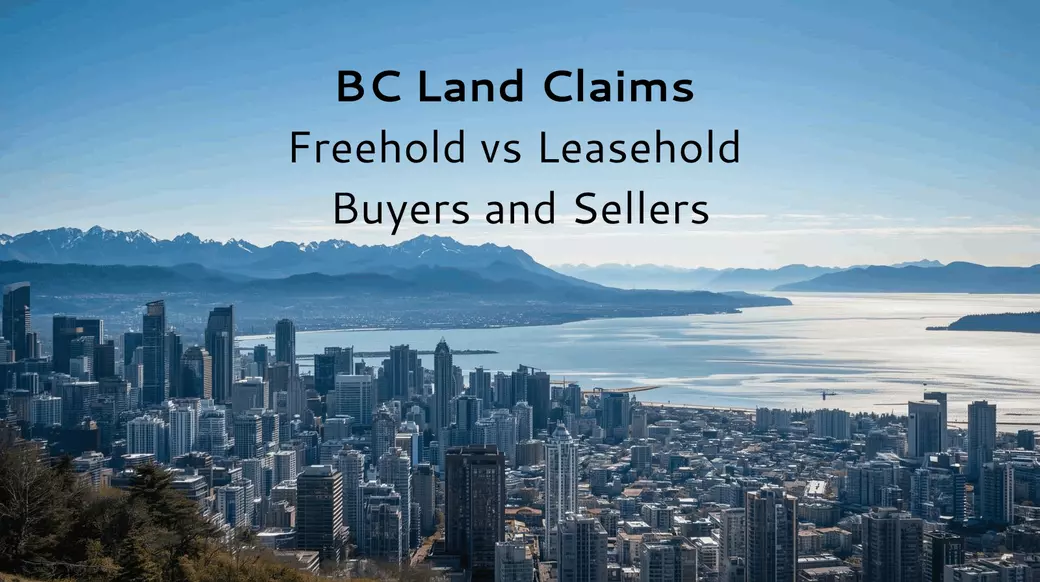
Land Claims, Freehold vs Leasehold, and Why Buyers Are Asking More Questions in BC
There has been a lot of quiet concern lately around land claims in British Columbia, particularly following recent court decisions affecting areas such as Richmond and now Kamloops. While this is a complex legal topic, it’s important to understand what is actually happening — and why buyers, lenders, and insurers are paying closer attention.
This is not about alarmism. It’s about awareness.
What’s happening in BC (simply explained)
In British Columbia, much of the province is unceded land, meaning historic treaties were never finalized in many areas. Over time, court decisions have expanded how Aboriginal title can be recognized.
A recent BC Supreme Court decision confirmed that Aboriginal title can be recognized as a prior and senior interest, even where fee-simple (freehold) title already exists. Importantly, this does not mean homeowners are suddenly being removed from their properties — but it does introduce uncertainty around how those overlapping interests coexist.
That uncertainty alone has real-world impacts:
-
Some lenders have paused or tightened lending
-
Mortgage renewals have been delayed or questioned
-
Buyers and insurers are taking a more cautious approach
-
Transactions can stall simply due to unanswered legal questions
Markets don’t like uncertainty — even when outcomes are unknown.
Why leasehold properties are now being discussed more
Leasehold properties — particularly those on Indigenous lands — have always required careful consideration. In normal circumstances, many buyers are comfortable with long-term leases (often 99 years) when the terms are clear.
However, given the current climate around land claims, buyers are naturally asking more questions, such as:
-
How secure is the lease?
-
What happens if broader land governance changes?
-
How do lenders and insurers view these properties today?
This does not mean leaseholds are being taken back, nor that Indigenous communities are seeking to remove residents. But when broader land title questions are being debated publicly, it’s reasonable for buyers to reassess risk — especially for long-term investments.
A useful comparison: New Brunswick’s recent ruling
To put BC in context, a recent New Brunswick Court of Appeal decision took a different approach.
That court ruled that Aboriginal title claims cannot result in declarations over privately owned (fee-simple) land. Instead, the court emphasized that:
-
Private property rights must remain certain
-
Reconciliation is better served through negotiation and compensation
-
Crown land may be addressed, but private owners should not be displaced
This decision contrasts with BC’s current legal landscape and shows that land claim outcomes are not uniform across Canada.
For those interested, this short video provides a clear overview of the New Brunswick ruling:
👉 New Brunswick Court Overturns Land Claim Ruling
https://www.youtube.com/watch?v=9SQPgyL8d-U
The key takeaway for buyers and owners
No two provinces are the same. No two properties are the same. And no single headline tells the full story.
What matters right now is:
-
Understanding where a property is located
-
Knowing whether land is freehold or leasehold
-
Asking how lenders, insurers, and title providers currently view that area
-
Getting legal advice before removing subjects, especially in sensitive locations
ADD THIS SECTION (near the end, before “Final Thoughts”)
Additional context from a leading Canadian legal expert
For readers who want a deeper understanding of how Canada arrived at this point, a highly respected and widely shared interview with Bruce Pardy, Professor of Law at Queen’s University and Executive Director of Rights Probe, provides valuable background.
In the interview, Professor Pardy explains — in plain language — how:
-
Canada’s Constitution protects Aboriginal rights, but does not explicitly protect property rights in the same way
-
British Columbia is uniquely exposed because much of the province is unceded land and because BC has incorporated the UN Declaration on the Rights of Indigenous Peoples (UNDRIP) into provincial law
-
Recent court decisions have introduced legal uncertainty not by removing ownership, but by allowing overlapping interests (Aboriginal title and fee-simple title) to coexist — something markets and lenders struggle to price or insure
-
Historically, when land claims are recognized, outcomes more often involve negotiation and compensation with the Crown, rather than displacement of private owners — but the lack of clarity creates hesitation in the interim
His key message is not panic, but certainty matters — and when certainty is missing, buyers, lenders, and insurers naturally become cautious.
For those who want the full explanation, the interview is well worth watching:
👉 The Real Story Behind Land Claims in Canada
https://www.youtube.com/watch?v=PtoSFE3X078
More of Professor Pardy’s work can be found at:
Final thoughts
This is not about panic. It’s about informed decision-making.
Real estate has always evolved alongside legal, political, and economic changes. The best approach — especially in uncertain times — is calm analysis, proper advice, and transparency.
For those who want a deeper legal explanation, this long-form interview with a Canadian law professor provides valuable background:
👉 The Real Story Behind Land Claims in Canada
https://www.youtube.com/watch?v=PtoSFE3X078
As always, buyers and sellers should consult qualified legal professionals regarding their specific situation.
Categories
- All Blogs (103)
- aboriginal title ruling (2)
- B.C. Policy (1)
- bc housing market (24)
- bc real estate (56)
- Bill C-15 (1)
- build canada homes (10)
- Buyers Guide (4)
- canada strong fund (4)
- Canada-U.S. Trade (2)
- canadian real estate (16)
- Canadian Real Estate & Housing (1)
- Climate Change (2)
- Cost of Living (2)
- Design & Build (4)
- Dundarave West Vancouver (1)
- Equity Growth (1)
- Federal Policy (1)
- freehold (1)
- Home Buying Tips (1)
- Household Debt (1)
- housing policy (1)
- land claims (2)
- Land Claims / BC Real Estate (1)
- leasehold (1)
- local news (1)
- Lower Lonsdale (2)
- Market & Policy Analysis (1)
- Market Commentary (6)
- market insights (23)
- Market Intelligence (1)
- Mortgage Delinquencies (1)
- Mortgage Renewals (1)
- Multigenerational Living (2)
- North Vancouver Real Estate (19)
- open house (1)
- Open House Security (1)
- presale (1)
- real estate insights (7)
- Real Estate Market & Housing (2)
- renovation (1)
- Squamish Market Update (7)
- squamish real estate (8)
- squamish update (3)
- Vancouver Real Estate (17)
- West Vancouver Living (15)
- West Vancouver Real Estate (26)
- Whistler Market Update (4)
Recent Posts





Have a Question? Let’s Talk. I’m Here to Help.

North Shore & Vancouver Realtor License ID: 175378
+1(778) 875-4934 | debbie.evans@exprealty.com